



An AI character bible is a production document that defines repeatable identity rules for AI-assisted drama: who the character is, how they speak, which visual anchors must not drift, how relationships change, and which continuity states later assets must respect. It is not a character sheet rendering tutorial. The bible feeds character sheets, storyboards, covers, promo briefs, and video direction.
Quick answer
An AI character bible is the source of truth for character continuity in drama production. It records identity, voice, visual anchors, relationship stakes, and state changes so every rewrite, storyboard, character sheet, cover, and video brief uses the same rules. It controls who the character is; storyboard grids control shot order; image tools render approved visual boards later.
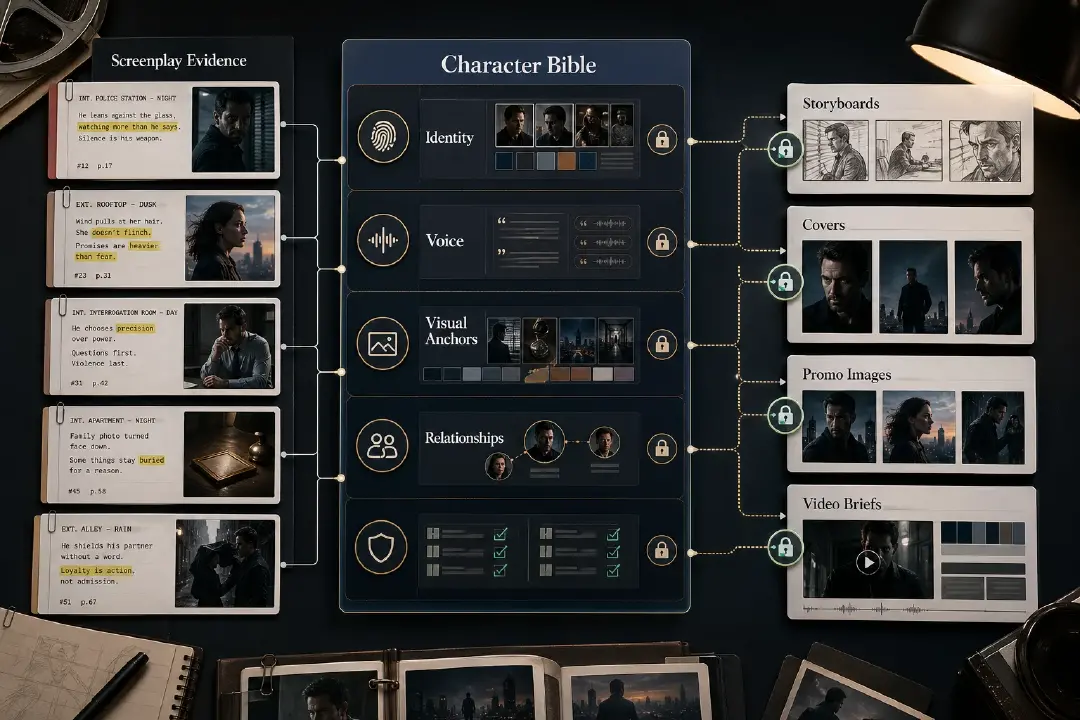
Visual guide: A character bible works best before images start drifting, not after the team is already cleaning up mistakes.
Boundary: character bible, storyboard grid, rendering
Use this page when the question is identity: face, silhouette, wardrobe logic, voice, emotional triggers, relationship stakes, and scene-by-scene continuity state. Use the storyboard grid guide when the question is scene order: which beat becomes panel 1, where the reveal lands, and how shots connect. Use the visual asset rendering guide after planning, when approved identity rules and shot plans are ready to become rendered character sheets, boards, or references.
Where character systems usually fail
Most weak character systems rely too much on one-off descriptions.
That works for a one-off test. It does not work well across episodes, revisions, covers, promotional visuals, and storyboard planning. The team ends up re-describing the same character in different ways, and each step introduces more drift.
The usual failure modes are familiar:
- the face shape, hair, or silhouette changes between storyboards, covers, and promo frames
- dialogue tone becomes generic because no one defined how the character speaks under pressure
- a signature prop becomes decoration instead of carrying narrative meaning
- wardrobe changes without a scene reason, making time and status unclear
- relationship framing stays static after a betrayal, confession, or power shift
- each new asset brief has to rediscover the same identity rules from scratch
That is the real job of a character bible: stop the team from rediscovering the same character over and over.
What goes into an AI character bible
A good character bible is not a lore dump. It is a practical working file for production.
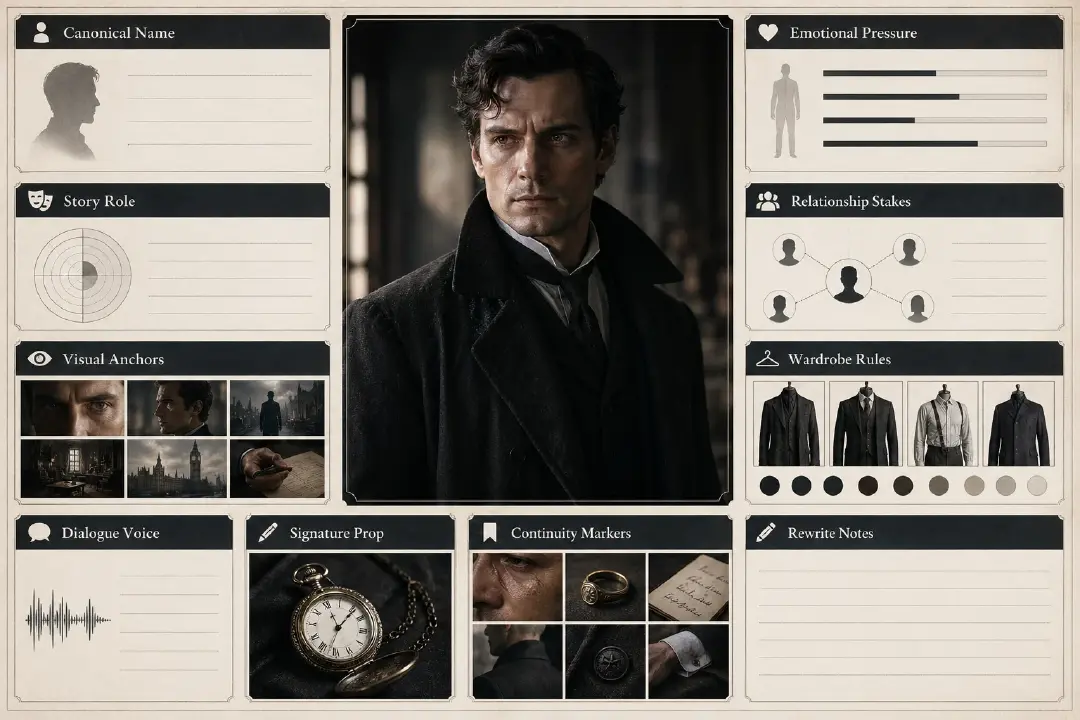
Each major character usually includes:
- canonical name and role
- age range and visual anchors
- motivations, fears, and narrative function
- dialogue traits and emotional triggers
- relationship stakes with other characters
- continuity rules that cannot drift
- allowed variation, such as wardrobe range or expression range
- scene-specific updates such as costume changes, injuries, secrets, or status shifts
The AI part matters because the rules must be clear enough for both creators and generation tools. If creators want the same character across storyboards, covers, promo images, and shot planning, the rules have to be explicit.
| Character bible field | What it captures | Why it matters for production |
|---|---|---|
| Identity rule | Name, age band, role, story function, non-negotiable traits | Keeps the cast consistent across assets |
| Voice rule | Dialogue style, pressure response, verbal habits, silence patterns | Helps rewrites and scene planning stay consistent |
| Visual anchors | Face shape, hair, silhouette, wardrobe logic, signature props | Gives later character sheets and boards stable inputs |
| Relationship rule | Trust, conflict, romance, leverage, loyalty, power shift | Connects character behavior to story logic |
| Continuity state | Injuries, reveals, costume changes, secrets, emotional status | Prevents scene-to-scene drift |
| Evidence source | Script line, approved reference, or production decision | Makes the rule auditable instead of arbitrary |
Character bible vs screenplay vs show bible
These documents overlap, but they do not do the same job.
| Document | Main purpose | Best use stage |
|---|---|---|
| Screenplay | Defines scenes, dialogue, and story beats | Primary source material |
| Show bible | Explains world, tone, and series logic | Development and long-form planning |
| Character bible | Protects identity, voice, and continuity rules | Pre-production and revisions |
| Storyboard or shot list | Plans visual execution scene by scene | After character and scene logic are clearer |
The screenplay tells the story. The character bible makes the story easier to produce repeatedly.
Character bible vs character sheet
A character sheet is a rendered or visual reference. A character bible is the rule system behind it.
The bible should decide what the sheet must preserve: face shape, silhouette, wardrobe range, signature prop, expression boundaries, and state changes. The sheet can then make those rules visible for review. If the team starts by rendering character sheets without a bible, identity choices become scattered across images, prompt fragments, and memory.
Why character bibles matter more in AI-assisted production
AI-assisted production often magnifies inconsistency. Every generation step may reinterpret the same character if the identity rules are vague. A one-off description can help once. A character bible helps repeatedly.
That helps with:
- keeping recurring characters visually coherent
- stabilizing dialogue tone across rewrites
- reducing fragile one-off descriptions
- making storyboards more consistent
- improving continuity between covers, promo art, and main scene assets
For short drama, manga drama, comic video, and longer episodic content, this is one of the most practical early assets a creator can maintain.
What a good character bible feels like
The right character bible feels less like background reading and more like production control.
Someone using it can answer practical questions fast. What never changes about this character's silhouette? Which prop is narratively attached to them? How do they sound under pressure? What relationship shift needs to affect later visual framing? Which scene introduces a state change the rest of the agent has to respect?
If the document cannot answer those questions quickly, it is still too close to lore and too far from production.
Review questions before using the bible
Before a character bible feeds storyboards or visual briefs, check:
- Can a teammate identify the character from the rule set without seeing a finished image?
- Are fixed anchors separated from allowed variation?
- Does the voice section explain pressure behavior, not just personality adjectives?
- Are relationship changes tied to specific scenes or episodes?
- Do injuries, secrets, wardrobe changes, and prop ownership have update triggers?
- Can a later storyboard grid use these rules without becoming a character design document?
How to build a character bible from a screenplay
The best path starts with the screenplay, not with style-first image requests.
- Find the first appearance, role, and function of each core character.
- Mark what the character wants, fears, hides, and protects.
- Pull visual evidence from the script and approved references.
- Record relationship stakes and emotional triggers.
- Track scene-by-scene changes that matter for continuity.
- Separate fixed identity anchors from allowed production variation.
- Rewrite the result into short rules, not long paragraphs.
The key is traceability. If a rule matters, the team can point back to the script or an approved production decision.
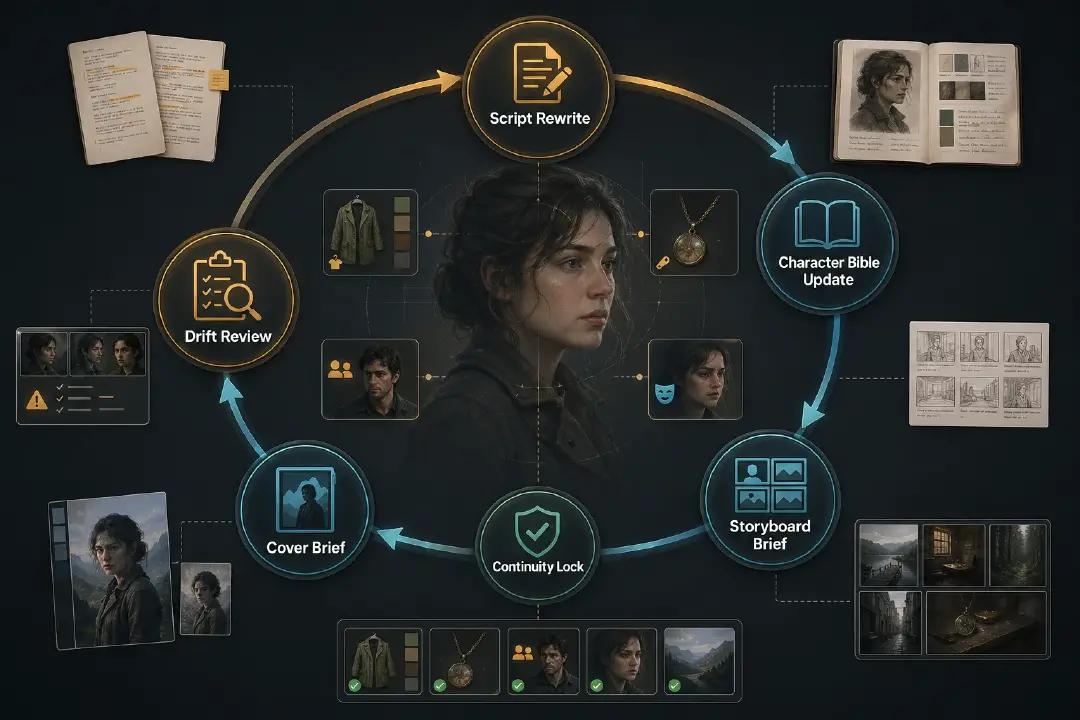
Example: turning one character into repeatable production rules
Suppose a screenplay introduces a lead character as a disciplined surgeon who avoids eye contact, always carries a silver lighter, and begins the episode emotionally controlled before breaking down in the final scene. A good character bible captures the role, emotional pattern, prop logic, speaking style, and scene-specific state changes. That gives image generation, storyboard planning, and continuity review a clear brief instead of forcing each step to reinvent the character.
The useful rule is not "cool surgeon in dark clothes." It is closer to: controlled posture until scene 9, avoids eye contact when lying, silver lighter must appear before the confession, white coat only in hospital scenes, clipped speech under stress, breakdown changes posture and eye contact for later panels.
When to use this system
Use a character bible when a project includes recurring characters, multiple scenes, or any visual production path that depends on continuity. It becomes especially valuable before storyboard creation, cover generation, and promotional asset production. For a one-off experiment, a full bible may be unnecessary. For episodic drama, it quickly becomes one of the most valuable early assets.
Render after identity rules are approved
Character bibles should not make the image model decide identity from scratch. The better handoff is: approved bible rules first, then a character sheet or visual board brief, then rendering, then continuity review. If the next job is a rendered character sheet, scene board, or 3x3 contact sheet, use the dedicated guide for visual boards after planning.
What Arcloop is building around character bibles
Arcloop is a screenplay-first video agent. In that system, character bibles matter because they connect script breakdown to production assets.
Arcloop is exploring ways its video agent can use screenplay analysis to inform:
- character identity cards
- voice and relationship rules
- storyboard planning
- cover and promo briefs
- video-ready shot planning
The careful framing is important. Arcloop is testing and building around this pattern. That is different from saying every step is already fully automated.
FAQ
Is an AI character bible the same as a show bible?
No. A show bible covers the larger world, tone, and long-form series logic. A character bible is narrower and more operational. It focuses on character identity, continuity, and repeatable production rules.
Do solo creators need a character bible?
If the project has recurring characters, multiple scenes, or episodic content, usually yes. A lightweight version still saves time.
Can a character bible guarantee consistency?
No. It improves consistency but does not guarantee it. Model behavior, reference quality, briefing discipline, and review still matter.
What changes after a rewrite?
Update relationship stakes, emotional state, reveals, physical continuity, wardrobe changes, prop logic, and any visual rule the new draft affects.
How does this help image and video generation?
It gives later tools clearer identity rules, which reduces drift in character appearance, dialogue tone, and relationship framing.