How to Turn a Drama Script Into Episode Cover and Promo Image Briefs
Most weak episode covers are not ugly. They are vague: the image looks polished, but it does not sell the episode-specific promise.
They fail in predictable ways. The conflict is hidden, the wrong character is centered, the symbolic object is missing, or the cliffhanger is reduced to a generic dramatic stare.
That is why script-driven cover work usually beats poster-first cover work. A screenplay already contains the material a strong cover needs: conflict, reversal, emotional focus, and symbolic details. The real job is choosing the right signal and not trying to cram the whole plot into one image.
Quick answer
Use this guide when one episode needs a cover, promo image, thumbnail, or teaser brief. Choose the script's strongest hook, conflict, symbolic object, or cliffhanger, then adapt that signal by channel. If the job is keeping many covers aligned across a full drama series, use the series consistency guide.
This page is the single-episode brief page. Use it when the question is, "Which script moment should become the cover or promo image, and how should that brief change by channel?" It does not cover long-term series consistency.
A cover is a decision before it is an image
An episode cover has to answer a simple question: what does the viewer feel or anticipate from this episode before they press play?
That answer usually comes from one of a few places:
- the central conflict pair
- the clearest emotional turn
- the reveal near the end of the episode
- a symbolic prop with narrative weight
- the moment of maximum tension before the break
If the team does not decide that first, the image model usually fills the gap with something broad and forgettable.
Find the hook in the script before you generate anything
| Asset type | Weak input | Strong input |
|---|---|---|
| Episode cover | "Make a dramatic poster" | Specific cliffhanger, reveal, or emotional beat |
| Promo image | "Generate a teaser image" | Character conflict, relationship tension, or visual motif |
| Thumbnail | Broad portrait | High-contrast scene hook with one clear focal point |
The hook does not need to be the biggest event in the episode. It needs to be the clearest sell.
Good places to look include:
- the first reveal that changes the episode's direction
- the relationship that carries the most pressure
- the prop or object the audience will remember
- the scene that best represents the episode's emotional promise
- the last beat before the episode break or cliffhanger
The cover brief names that signal clearly. If the team cannot say what the image is selling, the model cannot solve the problem for them.
Choose the subject that best carries the hook
Different hooks want different subjects.
| Hook type | Better visual subject | Common miss |
|---|---|---|
| Betrayal between two leads | The pair, with asymmetry or tension | A solo portrait that hides the conflict |
| Secret object or document | The object in the moment of discovery | A close-up with no story relevance |
| Episode reveal | The reaction beat or turning point | Trying to illustrate the entire plot |
| Romance under pressure | Distance, gesture, or interrupted contact | Default romance-poster symmetry |
| Threat or pursuit | Motion, obstruction, or looming presence | A static pose that removes urgency |
The strongest subject is the one that still explains the episode at thumbnail size. A cover is failing when it looks cinematic but removes the betrayal, document, interrupted gesture, or looming threat that makes the scene worth clicking.
Episode covers and promo images are not the same job
They can share one story signal, but they are not identical deliverables.
| Asset | Main job | Typical constraint |
|---|---|---|
| Episode cover | Represent the episode clearly | Needs to read as the episode's core promise |
| Promo image | Create curiosity or tension | Needs to work in feed formats |
| Thumbnail | Win fast attention | Needs one strong focal point at small size |
| Teaser poster | Sell tone and conflict | Can be broader than the episode cover |
The same hook can travel across all four. The composition still changes with the channel.
A practical path from script to cover brief
The production path is usually:
- Read the script for scenes, conflict beats, and possible hook moments.
- Pick one clear narrative signal for the episode.
- Choose the best subject: character, pair, prop, or scene.
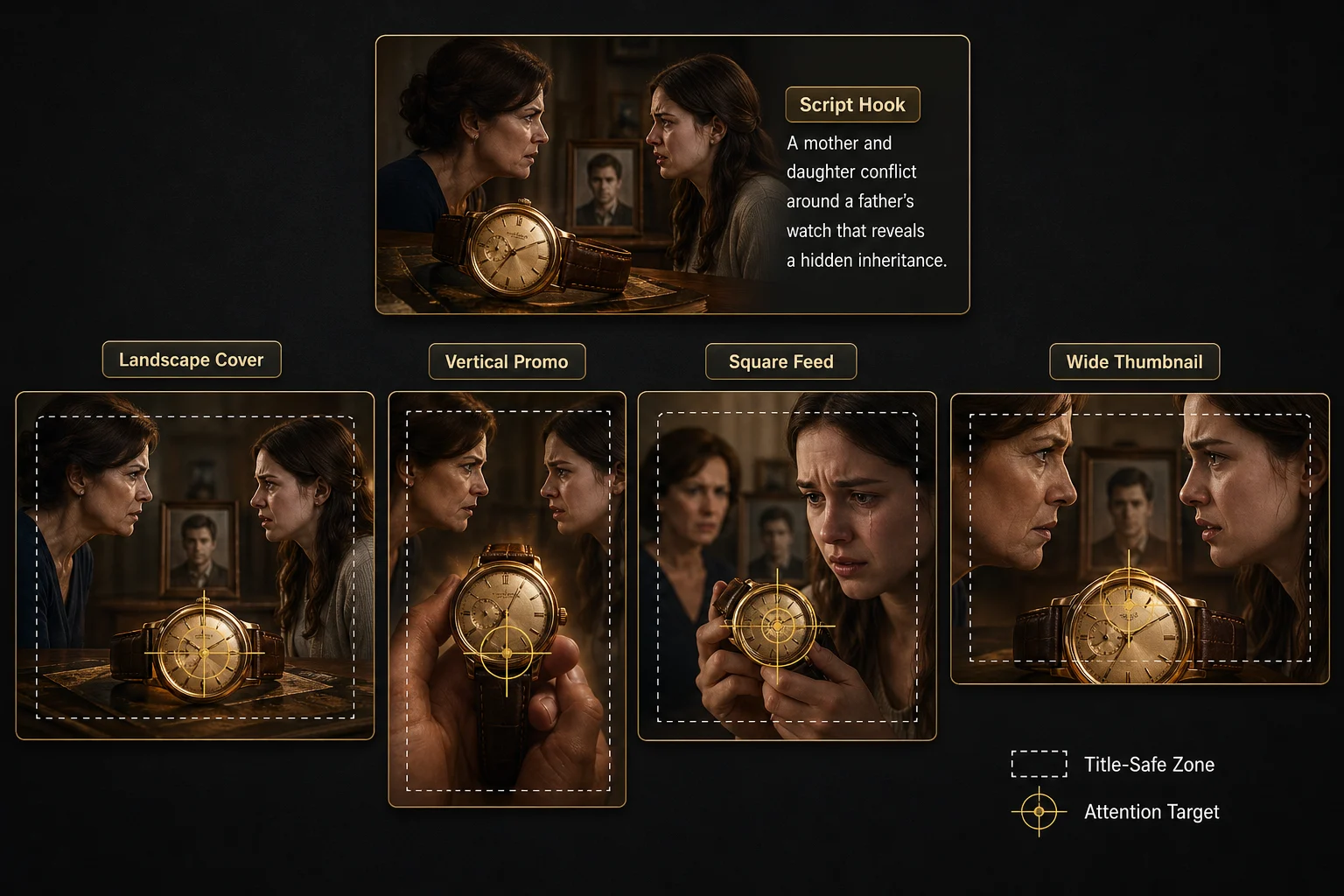
- Define framing, aspect ratio, and text-safe space.
- Generate a few candidates for different use cases.
- Review them for story fit before reviewing them for style.
This is slower than asking for one poster, but it produces assets that are easier to reuse and easier to defend editorially.
Example: a stronger cover decision from one scene
Suppose an episode centers on a mother and daughter conflict around a father's watch that reveals a hidden inheritance.
A weak request asks for "a dramatic family poster."
A stronger brief pulls out three specific signals:
- the mother-daughter conflict
- the father's watch as the symbolic object
- the hidden inheritance as the episode hook
Now the cover has a point of view. It is no longer a poster for the whole series. It is a visual promise for this episode.
What to review before shipping the image
Before approving a cover or promo asset, ask:
- Is the hook legible without reading the whole synopsis?
- Does the image match the actual story instead of a broad genre mood?
- Is the right person, pair, or object in the frame?
- Does the composition fit the target format?
- Would someone who knows the script say the image is honest?
Style still matters. It is just not the first test.
Where Arcloop fits
Arcloop is a screenplay-first video agent. In that system, covers and promo images come from script understanding rather than isolated image experiments.
That means the important part happens before generation:
- hook selection
- character and scene mapping
- visual brief construction
- format-aware image briefs
The product claim stays narrow: help creators turn scripts into episode-specific cover briefs and promo assets. One image request does not replace marketing judgment.
Common mistakes
- Choosing the most polished scene even when it hides the episode hook.
- Using vague image requests that ignore relationship tension or narrative stakes.
- Centering a character who is not driving the episode conflict.
- Treating thumbnails, promo images, and covers as interchangeable.
- Forgetting symbolic props that could make the visual more recognizable.
- Evaluating the image by style alone instead of checking whether it matches the story.
FAQ
What makes a strong episode cover?
A strong episode cover communicates the episode's clearest hook through character focus, conflict, tension, or a symbolic object with narrative weight.
Are promo images and episode covers the same thing?
No. They can share the same underlying hook, but they usually need different framing and formats.
Why start from the screenplay instead of an image request?
The screenplay gives you the narrative logic. That makes it easier to choose the right hook and build visuals that are specific to the episode instead of broad genre art.
How is Arcloop using this idea?
Arcloop is exploring how its video agent can use script analysis to shape cover briefs and promo image generation inside a larger screenplay-first production system.
What model fits this best?
Image models such as GPT Image 2 work better when they receive visual briefs derived from screenplay analysis.