How to Keep Episode Covers Consistent Across a Drama Series
If a drama runs for 20, 40, or 60 episodes, the cover problem stops being a design problem and becomes a systems problem.
The first few covers are rarely the issue. The trouble starts later, when the character hierarchy shifts by accident, the palette starts wandering, the title treatment moves around, and half the season begins to look like a different show. At that point the team is not missing creativity. It is missing a system.
Long-running drama projects need a cover language. Not 60 isolated posters.
Quick answer
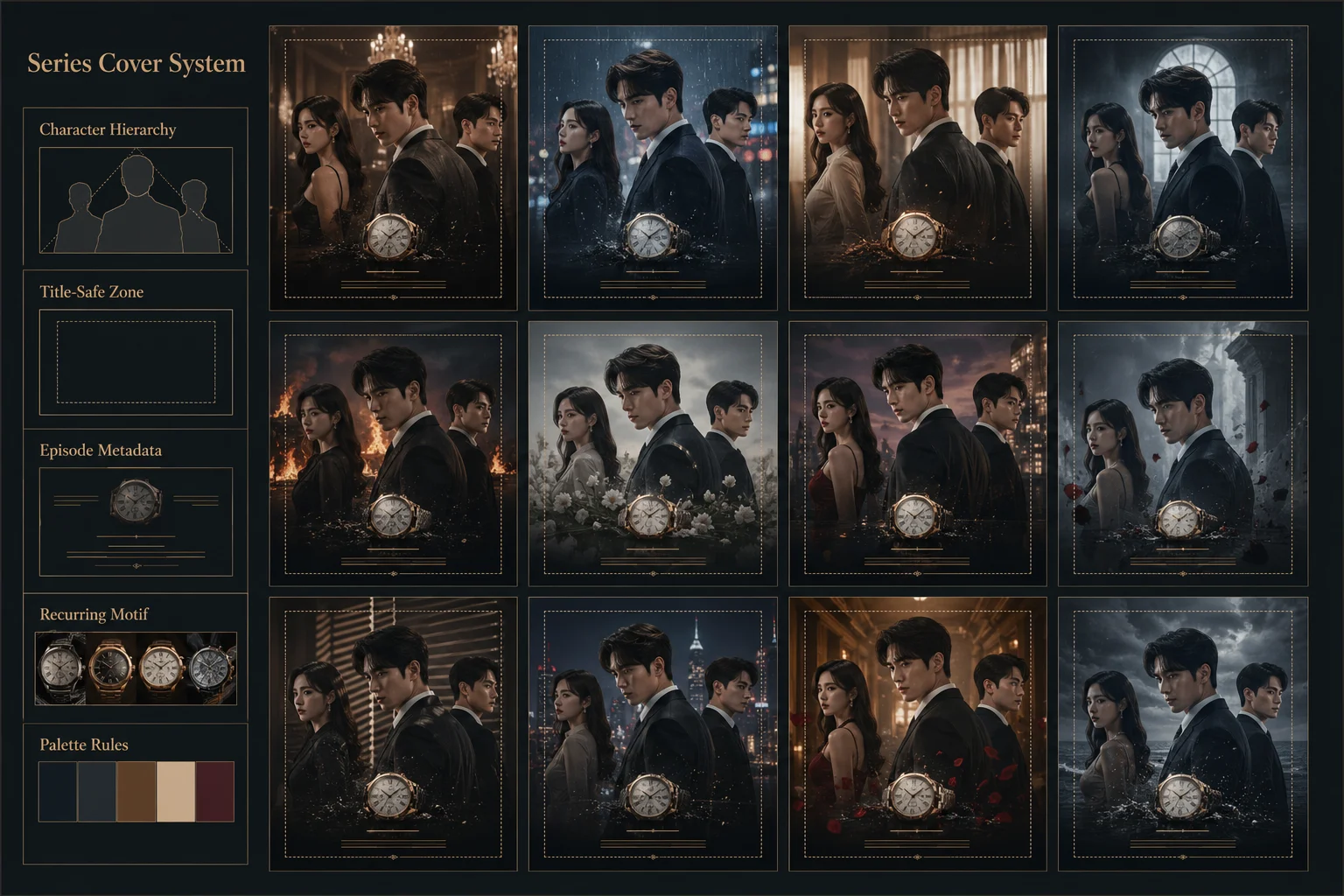
Use this guide when a drama series needs many episode covers to stay recognizable. Define fixed character hierarchy, layout rules, title-safe zones, motif logic, and arc-level variation before generating individual images. If the job is choosing one episode's script hook and producing cover or promo briefs, use the script-to-brief guide.
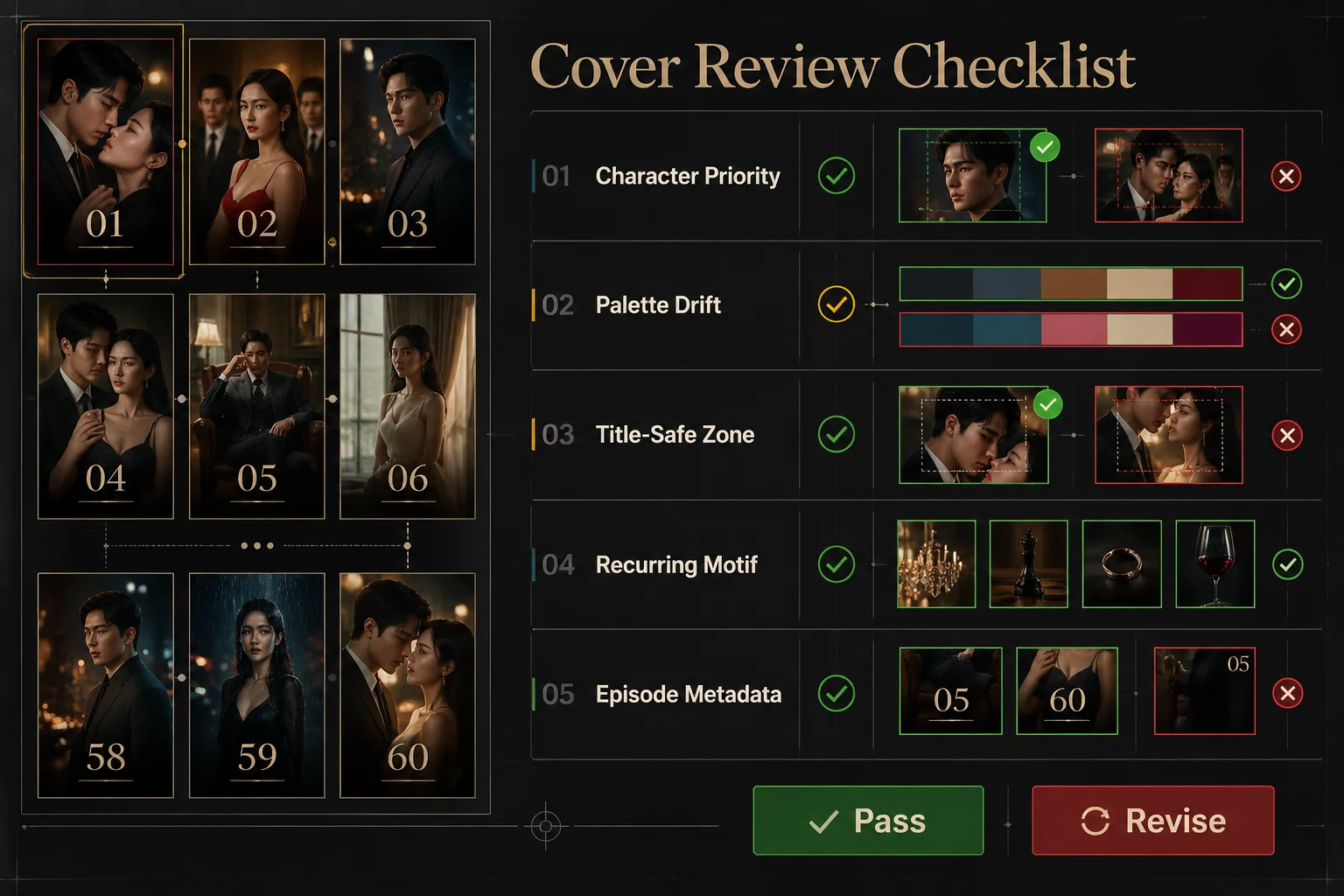
Visual guide: A cover system lets many episode images vary without losing the same title zone, lead hierarchy, metadata placement, and motif logic.
This page is the series consistency system page. Use it when the question is, "How do we keep dozens of episode covers recognizably from the same drama?" It does not choose the single best hook for one script.
One-off covers break over time
One-off covers can pass one-by-one review at the start because the visual language is still close to the original reference. Over time, the drift compounds.
The usual failure pattern looks like this:
- episode 3 introduces a new crop and everyone likes it
- episode 8 changes the palette to fit one scene
- episode 14 starts centering the wrong character
- episode 21 forgets the prop language that made the series recognizable
- episode 30 no longer feels like the same show
That is why a long drama series needs rules before it needs more images.
What stays fixed across the run
Episode covers can change, but the system behind them cannot drift.
| Cover system layer | What stays fixed | What can vary by episode |
|---|---|---|
| Lead cast logic | Who gets visual priority | Which pairing or conflict is foregrounded |
| Layout pattern | Safe title zone, face framing, focal composition | Cropping, gesture, prop emphasis |
| Color language | Base palette or tonal family | Escalation by arc, reveal, betrayal, romance |
| Branding | Series title treatment and episode metadata placement | Episode number, subtitle, promo tagline |
| Visual motif | Repeated props, locations, emotional cues | Which motif is highlighted for the current episode |
If those rules are undefined, the team is not really building a series cover system. It is just making many unrelated images.
Think in arcs, not 40 isolated covers
Most series do not need one visual rule per episode. They need one system that can stretch across phases of the story.
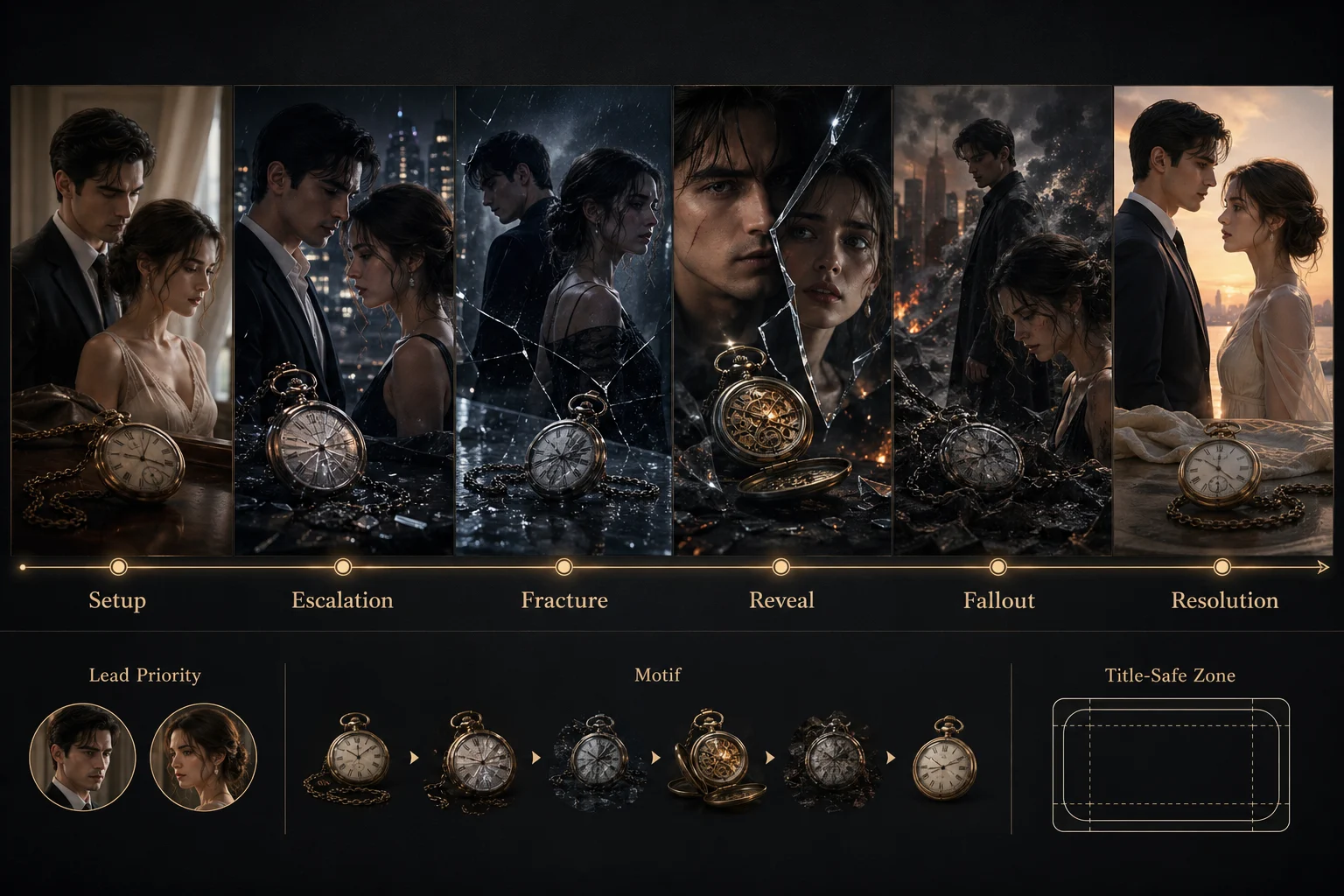
A practical series may group its covers into phases like:
- setup
- escalation
- fracture
- reveal
- fallout
- resolution
The lead pair may stay constant across all phases, while color tension, prop emphasis, and gesture change as the story hardens. That is much easier to manage than treating every episode like a blank slate.
Review the season as a strip, not one image at a time
A single cover can look strong on its own and still damage the season visually. That is why long series need sequence review.
A failure is not just an ugly image. It is a cover that moves the title block, promotes a secondary character too early, changes palette with no arc reason, or breaks the motif language.
Lay out 10 or 20 covers together and check for:
- character priority drift
- accidental palette jumps
- overused gestures or props
- title and metadata inconsistency
- episodes that look like they belong to a different series
The sequence test catches problems that individual approvals miss.
A practical system for series cover production
For long drama series, the production system usually looks like this:
- Parse the screenplay or outline for recurring cast, emotional arcs, and episode hooks.
- Define the permanent cover rules: character hierarchy, layout, palette family, and title-safe zones.
- Group the run into arc-level visual phases.
- Build phase briefs instead of starting each episode from zero.
- Generate covers in batches.
- Review them as a sequence and correct drift early.
That is the difference between generating covers and operating a cover system.
Example: a 60-episode short drama cover system
Imagine a 60-episode vertical drama built around a fake marriage, a hidden inheritance, and a late betrayal.
A weak production setup creates each cover separately and hopes the look stays close enough.
A stronger system defines:
- one lead couple who keep visual priority
- one secondary rival who enters only after a specific arc
- one inheritance motif that repeats without becoming a logo
- one layout system with fixed text-safe zones
- three palette phases that track the emotional temperature of the season
Now the season can evolve without losing its identity.
Single-episode cover logic and series cover logic are different
An episode cover asks, "What is the clearest promise of this episode?"
A series cover system asks:
- what never changes across the run?
- what is allowed to evolve by arc?
- how do we keep speed without losing identity?
Both problems matter. They are just not the same problem.
Where Arcloop fits
Arcloop is a screenplay-first video agent. In this context, series cover work matters because long-running projects need repeatable image systems, not isolated good images.
The operational value is clear:
- batched episode cover briefs
- recurring motif tracking
- fixed metadata placement
- arc-aware variation
- faster review of cover sequences
The claim is grounded. This solves a production bottleneck. It does not replace human taste.
Common mistakes
- Treating every episode as if it needs a completely new cover language.
- Approving an isolated strong image that breaks character priority, palette, or title placement.
- Ignoring title-safe layout zones until late in the process.
- Letting character hierarchy drift from one cover to the next.
- Reviewing covers one by one instead of as a full-season sequence.
FAQ
Does every episode cover need to be unique?
Not completely. Each episode can highlight a different hook, but the series still needs to feel visually consistent across the full run.
Why is this a bigger problem for long dramas?
Because the cost of inconsistency compounds. A 6-episode project can survive some drift. A 60-episode project usually cannot.
What is the difference between a cover system and a text library?
A text library gives you repeatable wording. A cover system gives you visual rules, hierarchy, and variation logic for the whole series.
How is Arcloop using this idea?
Arcloop is exploring how its video agent can use script structure, character continuity, and episode hooks to support more scalable cover generation for long drama series.
What model fits this system best?
Image models such as GPT Image 2 work better when they receive series briefs instead of one-off cover requests.