The real cost isn't money
When you make AI anime, you naturally want better quality: cleaner faces, smoother motion, sharper lighting, richer backgrounds, higher resolution, longer clips, and more cinematic camera work. The problem is that quality is expensive when the shot is not solved yet. A beautiful failed clip is still a failed clip. If the character drifts, the action is unreadable, or the camera misses the important beat, higher fidelity only makes the mistake more painful.
The first thing to control is cost. Cost does not only mean money. It also means time, attention, retry count, review fatigue, and the number of files you must compare before choosing one. The pattern is common: you spend far more than expected when you chase final quality before the scene has a stable plan.
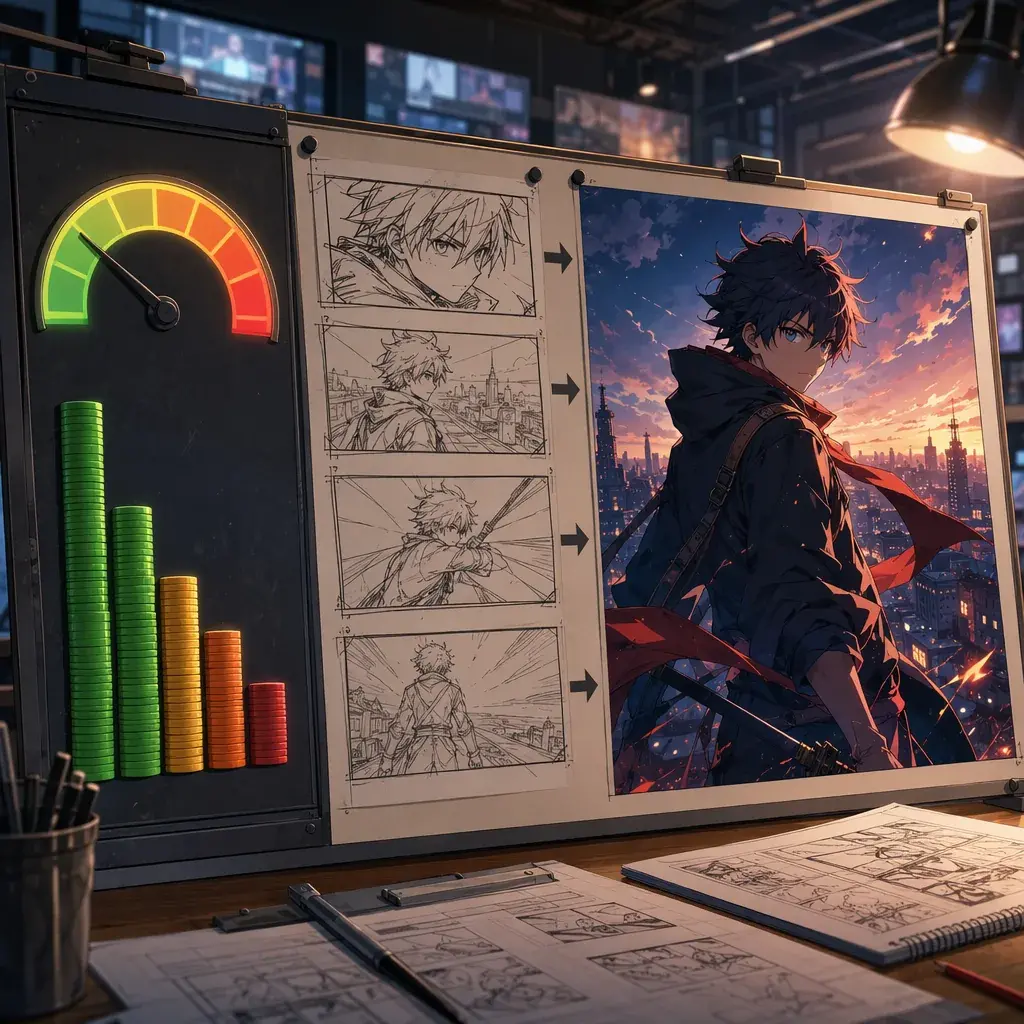
In ArcLoop, the practical version of that is a two-stage mindset: low-cost draft first, final-quality pass second. Drafts answer the cheap questions — does the character read? Does the action happen? Is the camera usable? Does the reference image solve the right problem? Only after those questions are answered should you spend on the higher-cost model for the final render. Use Low-Cost Draft to Final to keep that gate visible.
Rules before you spend a credit
The first principle is that every generation should have a review job. A draft is not supposed to be gorgeous. It is supposed to test framing, identity, timing, action, and continuity.
The second principle is to make clips shorter than your ambition. If you want a 30-second anime scene, test it as three to five short shots, not one massive prompt. Short shots fail smaller.
The third principle is to avoid paying for uncertainty. If you do not know the character design, do not generate final video. If you do not know the camera, do not upscale. If you do not know the story beat, do not add voice, subtitles, and effects.
The fourth principle is to define a retry budget before starting. Decide how many drafts you will run for identity, action, camera, and final polish. This prevents endless "one more try" loops.
The fifth principle is to simplify references. Use the right reference for the problem. A character sheet controls identity. A pose reference controls action. A background reference controls space and depth. Using all references for all problems creates noise.
How to run a two-stage workflow: draft first, final second
Start with the smallest story unit. Do not begin with "make an episode." Begin with "one character notices one event and makes one choice." That unit becomes a short shot or a three-shot board.
Set the success criteria before generation. For a draft, success might mean "the character keeps the same hair and jacket, enters frame left to right, and stops in a readable final pose." That is enough.
Write a rough prompt with fewer decorative demands. Keep the character, setting, action, camera, duration, and constraints. Remove premium detail such as dense crowd animation, complex reflections, long transformation effects, and heavy particle systems until the shot works.
Run the draft and grade it quickly. Use a simple pass/fail list: identity, action, camera, composition, continuity. Do not judge the rough pass by final art standards.
Revise only the failing part. If the camera failed, change the camera sentence. If identity failed, strengthen the character sheet or reference. If action failed, reduce the action count. Do not rewrite the entire prompt every time.
Move to final quality only after the draft passes. Add lighting, richer background, refined secondary motion, higher output settings, and final constraints. For motion-heavy shots, test the action first with Single Action Dance Clip.
Why quality-first breaks at the diagnosis step
Quality-first workflows often fail because the prompt becomes a wish list. You ask for a detailed OC, a cinematic environment, three emotional beats, multiple camera moves, accurate clothing, dialogue, background effects, and a final reveal. The model may produce something visually impressive, but it is hard to diagnose. Was the problem the reference? The action? The camera? The runtime? The style? The result gives no cheap answer.
Cost-first workflows are less glamorous but more reliable. A rough pass can use lower detail, shorter duration, simpler background, and one action. If that rough pass cannot produce the basic shot, adding more quality will not fix it. If it can, the final pass has a strong foundation.
This is also where reference selection saves money. Many users spend retries trying to describe consistency in text when the real issue is missing reference structure. A front, side, and expression character sheet can prevent dozens of failed face descriptions. A pose reference can avoid long action explanations. A storyboard can keep continuity from becoming a prompt guessing game.
The lesson is simple: do not buy polish for a shot that has not earned it.
Example 1: Cheap Draft Pass
Draft pass only. Create a 5-second rough 2D anime video of an original academy swordswoman entering a moonlit training yard. She has short black hair, a red scarf, a navy practice uniform, and a wooden sword. Camera: locked medium-wide shot from the front. Main action: she walks three steps forward, stops, and raises the wooden sword into a ready stance. Use simple cel shading, plain courtyard background, low detail, readable body movement. Evaluate only identity, full-body framing, action clarity, and final pose. No extra characters, no camera orbit, no complex particles, no text, no logo.
This draft avoids polish on purpose. It tests whether the core shot is worth improving.
Example 2: Final Pass After Draft Approval
Final pass based on the approved draft. Create an 8-second polished 2D anime scene of the same original academy swordswoman with short black hair, red scarf, navy practice uniform, and wooden sword. Moonlit training yard, wet stone tiles, distant lanterns, bamboo shadows moving in the wind. Camera remains a restrained medium-wide frontal shot with a slow push-in. Main action: she walks three steps forward, stops, exhales, and raises the wooden sword into a ready stance. Secondary motion: scarf lifts in the wind and lantern reflections tremble on the tiles. Clean line art, refined cel shading, cinematic blue-orange lighting. Preserve outfit, face, scarf, and sword. No added enemies, no sudden costume change, no text, no watermark.
The final pass adds atmosphere but does not add a new scene. That is the point.
Example 3: Retry Budget Prompt
AI anime retry plan for a 12-second short:

Goal: an original sky courier discovers a glowing letter and decides to deliver it.
Budget: 3 rough drafts for storyboard timing, 2 identity tests from the character sheet, 2 final video attempts per accepted shot.
Shot 1 draft: wide rooftop courier landing, locked camera, test silhouette and setting.
Shot 2 draft: insert of glowing letter in gloved hand, test prop readability.
Shot 3 draft: medium close-up as courier smiles and launches forward, test emotion and action direction.
Final rule: do not upscale or add complex city crowds until all three drafts preserve the same courier design and screen direction.
This is copy-ready as a planning prompt because it tells the workflow what each retry is allowed to solve.
The mistakes that burn your budget
The biggest mistake is treating the first generation as the final attempt. That puts too much emotional and financial pressure on an early, untested prompt.
Another mistake is changing multiple variables after every failure. If the face, camera, background, style, and action all change at once, you cannot learn what fixed or broke the shot.
Creators also overvalue high resolution too early. A sharp clip with wrong movement is not production-ready. Check motion and composition first.
A fourth mistake is ignoring the cost of comparison. Ten beautiful variants are not useful if none of them match the storyboard. Fewer, clearer drafts are easier to judge.
Finally, do not cut safety and review steps to save money. Input validation, rights checks, OC boundaries, and human review are part of cost control because they prevent expensive cleanup later.
FAQ
What is a good retry budget for a short AI anime clip?
For a single 6-10 second shot, start with two or three rough drafts, then one or two final attempts after the draft works. Increase only for shots that matter.
Should I always use low-quality settings first?
Use low-cost settings when you are testing composition, action, or continuity. If a setting hides the issue you need to inspect, raise just enough quality to judge that issue.
How do references reduce cost?
References reduce guesswork. A character sheet, pose reference, or scene reference gives the model a concrete anchor, so fewer retries are spent restating the same idea in different words.