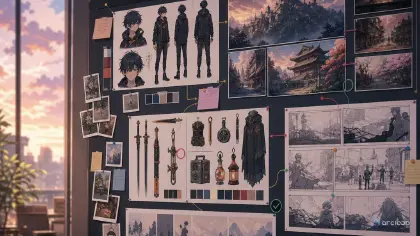


GPT Image 2.5 concept: structured output as separable assets A regular grid turns one generation into a reusable asset set. The grid can become a sprite sheet, a frame sequence, or a pose reference after it is split and reviewed in Arcloop.
Sixteen small characters in one image do not automatically make sixteen animation frames. A pose collection shows different states; a frame sequence must also preserve order, proportions, camera angle, and a stable anchor.
This original exercise follows five steps: define a small action, lock the mascot, generate a regular grid, split the cells, and check the anchor. The wave sequence breaks one movement into lift, swing, and return phases.

Start with one small action
Do not begin with a roll, jump, turn, and sword swing combined. Use a simple wave: the hand rises from the side, swings gently twice, and returns. When the body stays stable, motion errors are easier to see.
Prepare one original adult character or mascot reference. Keep the full body inside the canvas and record the number and position of important accessories.
Use the attached original mascot to create a 4×4 “raise a hand and wave” action sequence.
Use sixteen equal square cells, ordered left to right and top to bottom.
Cells 1–4: the right hand slowly rises from the side; 5–8: the palm swings outward;
9–12: the palm swings again; 13–16: the hand returns to the side, close to the first pose.
Keep the same character, costume, body proportions, and camera angle in every cell.
Keep the foot baseline and body center aligned; no limb may cross a cell boundary.
Use one light solid background with clear space around each figure. Add no text, numbers, or decorative lines.
Treat the first result as a candidate set. It may show poses without a correct progression or repeat a step. Review it before attempting playback.
Inspect the grid before splitting
Select the grid in Arcloop Canvas, choose “Split image,” then 4×4. The tool divides rows and columns; it does not understand frame order or normalize inconsistent cells.
| Check | Ready to split | Rebuild first |
|---|---|---|
| Grid | Equal, regular cells | Merged or unequal cells |
| Boundaries | Limbs stay inside each cell | Hands or feet cross gutters |
| Identity | Costume and accessories stay stable | Outfit or details change |
| Motion | Adjacent steps are understandable | Repeated frames or jumps |
After splitting, inspect each image at full size. Crop residual gutters consistently. Do not trim every frame tightly around the subject, or the character will jump and change size during playback.
Use one anchor to diagnose jitter
Jitter often comes from position drift rather than the intended action. Compare the foot baseline and body center in every frame. If body height changes while the hand rises, repair that frame or regenerate the short phase.
Regenerate frame 7 using the character and placement from frame 6.
Move only the right hand slightly outward and keep the arm naturally bent.
Preserve head size, foot height, body center, costume, and background from the reference.
Do not change the camera angle, add motion blur, or crop the ears or feet.
Output one standalone frame only, not a collage.

A repaired frame must still be checked between its neighbors. If a one-frame repair creates a style break, keep the character master and regenerate the shorter action segment.
GIF and image-to-video are different deliveries
Frame-by-frame GIF assembly needs confirmed order, frame duration, and a clean first-to-last transition. This Arcloop workflow generates, splits, and saves images; use a sequence-capable tool for GIF encoding.
Image-to-video begins from one approved keyframe. Continue from the Arcloop video model page and describe motion and camera behavior. Do not use the sixteen-cell grid as a first frame unless the grid itself should appear in the video.
The reviews are different: GIFs need stable anchors and a clean loop; video needs temporal coherence, limited deformation, and plausible movement. A sprite sheet alone does not make GPT Image a video model.
Deliver the original grid, sixteen independent frames, a frame-order sheet, and a failed-frame list. That package is much easier to animate and reuse than one unsplit collage.