

What kills a hook before the 3-second mark
A lot of AI short dramas open beautifully: a night scene, a slow-motion shot, a character's back, music building underneath. But there's no conflict in the first 3 seconds, the character changes the moment the shot cuts, a key prop gets covered by a subtitle, and multi-character blocking still hasn't been established — viewers have already swiped away. Rewriting one prompt over and over just means rolling more generations around the same weak hook. Build the character and any key prop as assets in My Assets first, reference them in shots with @, set the aspect ratio to 9:16 in the Story Brief, and the hook shot at least won't lose on a broken face or a misplaced prop.
The first 3 seconds of a short drama aren't there for mood — they're there to give a reason to keep watching. Start with the AI short drama guide to break down visual evidence and relationship conflict, use the character asset guide to keep the lead stable, then review title, cover, completion, and the follow-for-next-episode payoff together in the workspace.
Why the first 15 seconds matter more than the first 3
There are four common hook shapes: visual evidence, relationship conflict, risky action, and unexpected information. Visual evidence is "the contract's been swapped." Relationship conflict is "she got his name wrong." Risky action is "someone's picking the lock outside the door." Unexpected information is "a dead man just sent a message." All four can be shown directly on screen.
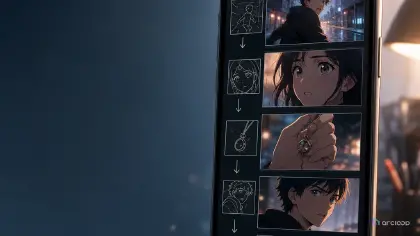
AI short dramas tend to end up with weak hooks because the prompt leans toward describing a mood. Something like "premium, cinematic, full of feeling" doesn't tell the system what needs to be on screen in the first 3 seconds. It works better to turn the hook into a shot-by-shot task: show the evidence from second 0 to 1, give the lead's reaction from second 1 to 2, and add decision pressure from second 2 to 3.
After the first 3 seconds, there's still the 15-second wall to deal with. Viewers of Chinese-language short dramas typically decide within 15 seconds whether a piece is getting to the point, and within 30 seconds whether it's worth finishing. For anything past 30 seconds, don't lean on one long take — stitch together 15-second beats instead: the first 15 seconds lands the hook and identity pressure, the second delivers evidence or pushback, the third pushes the cost up, and the ending closes on a reason to watch the next episode. Every beat should keep referencing the same character asset so pacing doesn't come at the cost of consistency.
The full pipeline is still concept → script → storyboard → video → voiceover → edit. The first-3-seconds hook gets locked in at the concept stage, broken into shots in the storyboard, timed with pauses in the voiceover, controlled for pace in the edit, and tied to title, cover, and the next-episode hook in the commercial review. Pair the AI short drama guide, storyboard templates, and character asset guide for this.
How to build a hook shot by shot
Step 1: write the hook into the concept. Don't just write a genre — write out what viewers will see in the first 3 seconds. If you can't picture it, the concept isn't video-ready yet.
Step 2: cut the explanatory opening. World-building, relationships, and backstory can all come later. The first 3 seconds should show an anomaly.
Step 3: storyboard the first 3 seconds. Second 0 to 1: an object or action. Second 1 to 2: the lead's reaction. Second 2 to 3: a line or new pressure. Three small beats hold up better than one long take.
Step 4: control framing. In a vertical frame, the hook needs to read clearly. A close-up on the evidence, a facial reaction, a medium shot confrontation — all work better than a wide atmospheric shot.
Step 5: keep voiceover lines short. No long lines in the first 3 seconds. A short question, a half-finished line, or a pause can do the job. When AI voiceover sounds like it's reading a script out loud, the line is usually too long or too emotionally flat.
Step 6: leave hard cut points in the edit. Don't let a hook shot linger. Cut straight from evidence to reaction, and from reaction straight to pressure.
Step 7: close the commercial loop. Title, cover, the first 3 seconds, and the ending should all be telling the same story. The cover promises conflict, the first 3 seconds delivers it, the ending extends it, and the next episode picks it up. That's what makes an approach work at volume.
Step 8: build a hook library of your own. Sort effective first-3-second openings into types: evidence close-up, mistaken glance, identity reveal, approaching danger, an odd message, a relationship reversal. Keep one storyboard pattern, one voiceover pace, and one cover candidate for each type. The next batch of AI short dramas doesn't need a new opening from scratch — just swap the character asset, the prop, and the conflict text. The character asset works like an identity record: look, color palette, props, and voice stay fixed, and only the event changes. Commercially, this speeds up concept testing and cuts down on generations wasted on random rolls.
Before you generate your hook Shot, spend five minutes setting up the assets that will keep it consistent across the whole Episode.
Open your IP Project and go to My Assets. Create a Character asset for your lead — give it a name, then go to Library, upload your reference photos, and Bind the clearest face photo as the Main image. Bind a side-angle or costume photo as a Reference image. Do the same for any key prop that appears in the hook (a contract, a phone, a specific object) — create a Prop asset and Bind its image.
Back in your Episode, click Generate Shots. When the shot cards appear, find the hook Shot and write the description using @ to reference what you just built: @Lin Zhixia instead of a paragraph describing her hair and blazer, @the contract instead of re-describing the prop. Keep the rest of the description to what is new in this single Shot — the camera angle, the action, the light, the one line of dialogue.
Generate the image first and confirm the framing and face before you generate the video. If the composition looks right, use AI Chat Panel to move fast: "Generate videos for Shots 1, 2, and 3." Once the hook videos are ready, open Edit, arrange the three beats on the timeline, trim any dead frames at the head or tail, and check that the cut from evidence to reaction to pressure lands within 3 seconds total.
Copy-ready prompts and shot specs
Example 1: First-3-Seconds Hook Design
Generate a first-3-second hook plan for a 60-second vertical AI short drama featuring @Lin Zhixia in the @downtown office scene. Output: one-line concept, frame for seconds 0-1 (object or action), frame for seconds 1-2 (lead reaction), frame for seconds 2-3 (decision pressure), one short line of dialogue, voiceover emotion, cut point, cover candidate, title candidate, and next-episode hook. The hook must be shown directly on screen — no narration to explain it. Follow the pipeline: concept, script, Storyboard, video, voiceover, Edit. Include a commercial read: paid acquisition, compilation, or character IP.
Example 2: Hook Shot Video Prompt
Generate a first-3-second vertical hook Shot for an AI short drama. Seconds 0-1: close-up of @the contract on @office desk, red seal name crossed out in ink. Seconds 1-2: medium close-up of @Lin Zhixia in right foreground looking down at the contract, pupils tightening, jaw set. Seconds 2-3: she looks up toward the left background and says quietly, "This isn't what I signed." Pull @Lin Zhixia's Main image and Reference images for look and side angle. Keep short black hair, cream blazer, silver stud earring unchanged across all three seconds. Lighting: cool white overhead office light. No slow build, no empty establishing shots, no face changes between seconds.
Example 3: Pacing Review Prompt
Review the first-3-second pacing of this AI short drama Episode. Check each point: does it open on conflict or visual evidence rather than mood; does @the lead react within 2 seconds; is there decision pressure before second 3; are dialogue lines under one short sentence; does the AI voiceover sound natural or like it is reading aloud; does the Edit cut cleanly at each beat; does the framing suit a 9:16 vertical frame; do the cover and title promise the same conflict the hook delivers; does the ending set up the next Episode. Output one of: pass, fixable in Edit, or needs a redo. Add a commercial read: better suited to paid acquisition, a compilation, or building toward a character IP.
When the hook lands but viewers still leave
The first failure mode is using mood as the hook. The fix is switching to evidence, action, a question, or unexpected information. A nice-looking background can't substitute for conflict.
The second failure mode is explaining before the conflict lands. The fix is showing the anomaly first, then filling in the explanation with later lines.
The third failure mode is lines that run too long in the first 3 seconds. The fix is cutting the line down to one short sentence, or even just half a line and a pause.
The fourth failure mode is a hook that doesn't match the title. The fix is having the title, cover, first 3 seconds, and ending all circle the same conflict.
The fifth failure mode is chasing a single click without thinking about the series. Commercially, a good first 3 seconds shouldn't just make someone stop scrolling — it should make them want the next episode too.
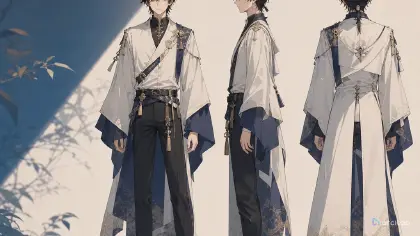
The sixth failure mode is a hook shot that's disconnected from the character asset. No matter how striking the first 3 seconds are, if the lead's Main image, Reference image, and later shots don't match up, viewers will notice. Hook shots need to reference the character asset too — impact shouldn't come at the cost of character stability. On terminology: the base character asset covers identity, the Reference image covers front/side/back, the Reference image covers 3/4 turns, the character asset covers full-page review, and the character asset itself is what generation calls on long-term. A hook shot needs to be tied to the character asset at minimum.
FAQ
Does the first 3 seconds always need a line?
Not necessarily. Strong visual evidence can carry it without a line. Use a line only when it amplifies the conflict.
Can an AI anime drama's first 3 seconds be slower?
It can have more of a mood, but it still can't be empty of information. An AI anime drama also needs a visual anomaly, a character reaction, or a twist promise in the first 3 seconds.
Which matters more, the hook or the ending?
The hook is what makes someone stay. The ending is what makes someone come back. A commercial short drama needs to design both — not just the opening.