Stop auditioning voice libraries one preset at a time. The more stable way to create a character voice is to write it as a card: derive the base from the character sheet, add one signature detail, and save it as a reusable production asset.
Do not start with the voice library
If you only browse a voice library, the character drifts. Episode one may use a low male voice; episode two may switch to a softer voice because the line is emotional. The audience hears it as a different person.
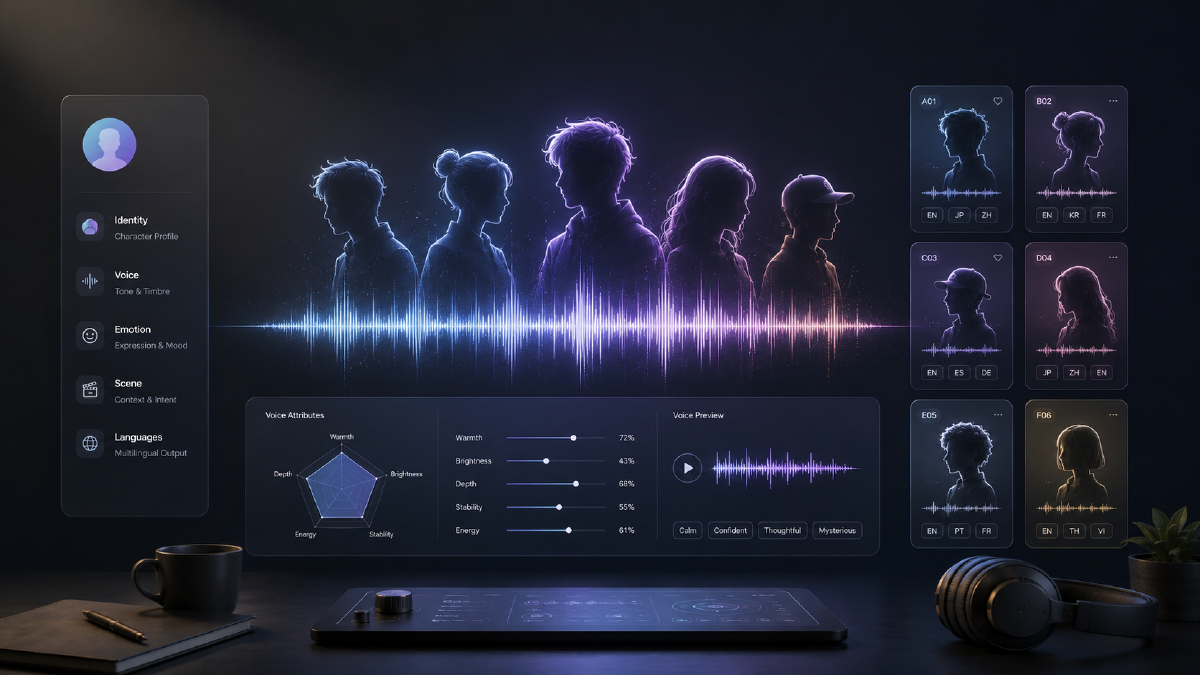
A steadier workflow is to write the voice as a character card. The card is not a long biography; it breaks voice direction into reusable fields:
- Character setup: who this person is, what relationship they are in, and what pressure they are under.
- Voice: age range, gender expression, register, texture, breath, and distance.
- Speaking style: pace, pauses, stress, endings, and how emotion is controlled.
- Scene: who they are speaking to, where they are, and their physical and mental state.
- Line: the actual sentence or paragraph to generate.
Voice defines who it sounds like; speaking style defines how the character performs. Voice alone often becomes narration. Speaking behavior makes it a character.
How to write each character-card field
The useful split is between character setup and executable voice direction. The first tells you the direction; the second changes the generated audio.
- Write relationships, not resumes. Focus on who they are talking to, what pressure they feel, and why they say this line.
- Write audible traits. Age range, register, brightness, rasp, breath, and distance work better than abstract mood words.
- Write behavior. Where the pauses land, which words carry stress, and whether endings close or rise matter more than swapping voices.
- Write the present constraint. A whisper, a phone call, an interrogation room, and a hallway at night do not sound the same.
- Give the line one acting goal. Comfort, test, threaten, apologize, flirt, hide, or command. One action per take is easier to control.
A reusable card still suggests how the character speaks after the line is removed. If it only explains the plot, it has not reached the voice layer yet.
The three-step voice card method
Derive the base
Social persona controls volume and endings; life history controls rasp and breath; occupation controls diction and rhythm.
Add one memory hook
Use one contradiction, tic, or signature sound. Two at most. More than that blurs the voice.
Lock the reusable card
Keep [Voice] and [Signature] unchanged across episodes. Only [Scene] and [Line] change per take.
Four rules for deriving voice from character
When no template fits directly, derive the voice from the character before browsing presets.
- Social position controls volume and politeness. Power speaks with fewer explanations; a request uses more hedging, pauses, and testing.
- Physical state controls breath and pace. Exhaustion, illness, panic, crying, or running should affect breathing, pauses, and diction.
- Relationship controls distance. Familiar speakers omit words, interrupt, lower volume, or leave sentences unfinished.
- Conflict style controls emotional leakage. Some characters explode; some become more polite when angry. Decide whether emotion leaks first.
If identity, body state, relationship, and conflict style never reach the instruction, the output usually sounds like generic narration.
Use this full card format
[Character] Julian Vale, heir of an old family. Cold and impeccably mannered on the surface; chronically ill, and tonight he knows he will not last.
[Voice] Adult male, late 20s. Soft, breathy, barely above a whisper; polished diction worn thin by illness. Slow pace, long pauses for breath.
[Signature] The weaker he gets, the more amused he sounds; half a beat of silence before your name.
[Scene] Deep night, first snow outside. He gently pulls the crying person at his knee into his arms.
[Line] Shh... don't cry. Come here, closer. I'm cold.
20 editable character voice templates
This is the editable pack. Each card keeps the essential voice base and signature. Choose the closest card, then replace the character, scene, and line.
You do not need to listen through all 20 templates. Group them by creative use case first, then modify the closest one.
- 01-10: English drama, commercial, and narration patterns for dramatic tension, ad reads, suspense narration, heroic roles, and children stories.
- 11-14: Korean relationship voices for intimacy, whispering, teasing, care, and light emotional shifts.
- 15-18: Japanese anime and soft-spoken voices for anime roles, whispers, gentle narration, and character-led lines.
- 19-20: Brazilian Portuguese warm and playful voices for friendly, light, smiling delivery.
How to use the previews without testing randomly
The previews are not for picking your favorite voice. They help you decide which part of a template is reusable.
- Choose a character type first: intimate, authoritative, suspenseful, commercial, anime, childlike, or narrator.
- First pass: listen only for base voice, such as age, register, brightness, breath, and distance.
- Second pass: listen for behavior, such as pauses, stress, endings, and emotional control.
- Change only one variable per retry. Do not change voice, pace, emotion, and line at the same time.
- Lock it once usable. For serialized characters, keep voice and speaking style fixed; change only scene and line.
20 Template Previews
20 Charakter-Sprachkarten
Wischen Sie durch die Vorschauen. Jede Karte zeigt Charakterkunst, Stimme, Sprechstil und Linie.

- Stimme
- male, late 30s, warm low baritone, faint rasp
- Sprechstil
- slow and steady under exhaustion, long pauses, never raises his voice
- Zeile
- Hey… look at me. You're okay. I've got you — just breathe with me, alright?

- Stimme
- female, smoky alto, breathy
- Sprechstil
- languid, trailing endings, a knowing half-smile in every line
- Zeile
- Play it again, sugar… slow. We've got nowhere to be but here.

- Stimme
- male, early 20s, light and quick
- Sprechstil
- fast, upbeat, trips over words when flustered, breathy little laughs
- Zeile
- Oh—oh gosh, sorry, one oat latte, extra hot—careful, it's, um, really hot!

- Stimme
- male, 50s, gravelly, low
- Sprechstil
- terse, long silences, every word lands like it cost him something
- Zeile
- Thirty years on the job. People lie. The scene doesn't.

- Stimme
- female, crisp, cool, precise diction
- Sprechstil
- composed and polite, emotion held down, turns to ice when tested
- Zeile
- I'll give you that one step. But don't test me on the next.

- Stimme
- male, neutral, warm, bright
- Sprechstil
- open and quick, easy laughter, endlessly encouraging
- Zeile
- Okay, okay—hear me out. This is the best worst idea we've ever had. Let's go.

- Stimme
- female, cold, controlled, commanding
- Sprechstil
- measured, clipped, no wasted words, a threat wrapped in courtesy
- Zeile
- You have my attention for ninety seconds. Do not waste it.

- Stimme
- male, 60s to 70s, soft, warm, unhurried
- Sprechstil
- slow and fond, a little rambling, a smile in the voice
- Zeile
- Time's a funny thing, kiddo. Slow it down enough… and it starts to feel like plenty.

- Stimme
- female, breathy, gentle
- Sprechstil
- quiet and hesitant, sentences that almost apologize for themselves
- Zeile
- Um… it's due back Thursday. But… take your time. I don't mind.

- Stimme
- male, low, unhurried
- Sprechstil
- soft and even, the quieter he gets the more frightening, a smile you can hear
- Zeile
- Sit. Please. We both know you're not leaving until I've finished talking.

- Stimme
- male, 30s, low and gentle
- Sprechstil
- calm and clear, patient, sometimes pauses briefly to think
- Zeile
- 천천히 대답해도 돼요. …그냥, 아무도 그렇게 물어봐 주지 않았을 뿐이니까.

- Stimme
- female, sweet and soft, slight nasal tone
- Sprechstil
- playful and coaxing, endings lift and stretch, good at push-and-pull teasing
- Zeile
- 가지 마… 딱 오 분만. 응? 오 분만 더 있으면 안 돼…?

- Stimme
- male, low and flat, almost no pitch variation
- Sprechstil
- short, clipped phrases; tenderness always leaks out late and reluctantly
- Zeile
- …춥잖아. 이거 입어. 딴 뜻 없으니까 오해하지 말고.

- Stimme
- female, languid and low, breathy
- Sprechstil
- very slow and soft, long silences, as if whispering close to the ear
- Zeile
- 오늘도 수고했어요. …이제, 아무것도 안 해도 되는 시간이에요.

- Stimme
- male, low and raspy, breathy and sensual
- Sprechstil
- very slow, long pauses, trembling endings, fragile beneath the tough front
- Zeile
- 泣くなよ……らしくない。ほら、もう少しだけ、そばにいろ。

- Stimme
- female, late 20s, low whisper, breathy
- Sprechstil
- whispered throughout, generous pauses, close-to-the-ear distance
- Zeile
- 今日も一日、おつかれさま。……もう、何も頑張らなくていいからね。

- Stimme
- male, late teens, bright and clear
- Sprechstil
- fast and bouncy, rising endings, laughs often
- Zeile
- おい見ろよ、あの夕焼け!……急げ急げ、消えちまう前に!

- Stimme
- androgynous, soft, calm voice
- Sprechstil
- quiet and polite, slow, slightly shy, chooses words carefully
- Zeile
- 返却は木曜まで……あ、でも、ゆっくりで大丈夫ですよ。

- Stimme
- male, warm, slightly husky
- Sprechstil
- playful and charming, lilting rhythm, a smile in the voice
- Zeile
- Calma, meu anjo… senta aqui. Com você por perto, o dia todo fica melhor.

- Stimme
- female, soft and warm
- Sprechstil
- slow and patient, welcoming tone, never raises her voice
- Zeile
- Respira fundo. Errar faz parte… a gente aprende junto, no seu tempo.
How to make a template your own
- Replace [Character] first, before changing adjectives.
- Keep the base, then adjust only one or two signature details.
- Make [Scene] concrete: who, where, and what state.
- For the same character, change only scene and line in future takes.
The 4 easiest mistakes when writing character voices
- Stacking adjectives. Keep one primary voice and one behavioral signature per card.
- Writing emotion as a label. “Sad” is vague; “trying not to let the other person hear the tears” is controllable.
- Rewriting the voice every time. Keep the same character voice fixed across scenes.
- Translating across languages too literally. Preserve the relationship, then re-derive voice and sentence endings for the target language.
FAQ
Can these cards work in any voice model?
The frame can. Any model that accepts natural-language voice direction can use the card, but tags and parameters still need model-specific adjustment.
Can one card work across Chinese, English, Japanese, and Korean?
The frame can, the values cannot. Voice expectations are cultural; translate the character, then re-derive the voice.
Can I use this to clone real actors or existing characters?
No. These cards are for original character-type voices, not unlicensed imitation of real people or copyrighted characters.