Why your creature keeps sprouting human parts
You prompt a tiny library spirit made of folded paper. In the first image, it has a clever triangular body, bookmark arms, and ink-dot eyes. By the second shot, the model gives it a human face. By the third, it has hair, fingers, shoes, and a school uniform. The "nonhuman" character has been quietly pulled back into a human mascot because the prompt never protected its species logic.
In the first half of 2026, anthropomorphic-animal series became the fastest-growing lane in AI short drama — several fully AI-generated animal series crossed a hundred million cumulative plays. What those hits share is exactly the subject of this guide: the species logic holds, so the character holds. Audiences will happily accept a cat plotting revenge; they will not accept it quietly growing human hands.
Nonhuman character design for AI anime needs more than "cute creature" or "robot sidekick." A creature, spirit, object, plant, mascot, or machine needs a body rule. How does it stand, show emotion, bend, or refuse to bend? What must never become human?
ArcLoop is useful because you can build that rule as a character asset before asking for shots. Start with Character Profile Fields, connect it to Creative Worlds, and keep a continuity checklist beside each generated take. When the character needs sound or dialogue, set its voice on the character asset and generate the voiceover from Edit.
This guide explains how to design nonhuman AI anime characters that stay expressive without defaulting to human anatomy. The examples use a paper library spirit named Quillbit and a tide-pool courier machine named Rooko.
The rules that keep species logic intact
Start with the silhouette. A nonhuman design should be recognizable as a black shape before details appear. Round, triangular, segmented, floating, boxy, vine-like, shell-backed, or cloth-draped silhouettes all create different personalities.
Define the anatomy rule. If the character has no hands, do not let the model invent fingers later. If it has four legs, say how they attach. Anatomy rules are continuity rules.
Use eyes carefully. Eyes are expressive, but they can humanize too much. Decide whether the eyes are dots, glowing slits, glass lenses, stitched marks, painted icons, or reflected lights.
Make emotion physical. A paper spirit can fold tighter when afraid; a robot can dim its lens or rotate an antenna. Nonhuman emotion should come from the body material.
Separate cuteness from baby features. A character can be appealing through proportion, timing, and behavior without copying infant human traits. Avoid generic "big baby eyes" if it fights the species logic.
Plan sound and voice as design layers. Some nonhuman characters speak, some chirp, some use bells, page rustle, mechanical clicks, or projected symbols. Keep these notes attached to the character profile and storyboard.
How to build a nonhuman design: from silhouette to shot
Write the reject first: "do not turn the paper spirit into a human child," "do not add fingers to the shell machine," or "do not replace moss texture with fur." This is not a negative-prompt dump; it is the core production risk.
Choose the origin object or species: folded receipt, teapot golem, coral courier, wind-up bird, lantern plant, or bus-stop ghost. The origin gives material, movement, and limits.
Define the shape language with two or three words: triangular folded body, round glass head, segmented shell legs, ribbon tail, square backpack, or leaf-like ears.
Write the movement rule. Nonhuman characters need animation verbs that match the body: hops, skitters, unfolds, swivels, floats, pulses, rolls, hinges, blinks a lens, puffs steam, rustles pages, or tucks leaves. Generic walking can collapse the design into human legs.
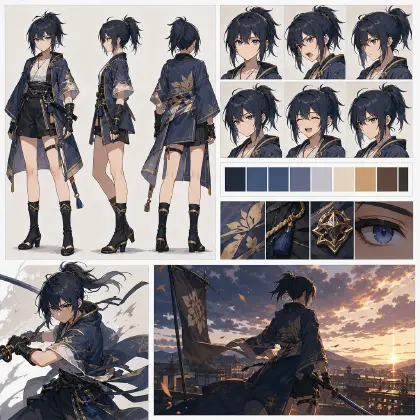
Create a character asset in ArcLoop. Include front, side, expression states, scale comparison, material notes, and forbidden human additions.
Test three shots: idle, emotion, and action. The character should survive all three without changing anatomy.
Save the design rule on one shot card: silhouette, anatomy, eyes, material, motion, and reject list.
Build the body rule once, save it as a character asset
Build the nonhuman design once as a character asset — anatomy, material, and the reject list all live there — then reuse it with an @ reference in every shot and episode, instead of re-describing the body rule each time. The storyboard is where emotional beats change shot to shot; the anatomy underneath does not.
Use Continuity Check Board when the creature appears in multiple shots. Check silhouette, material, eye type, and movement before polish.
For voice and sound, keep the performance tied to the creature's body. A paper spirit can rustle and tap; a machine can click, hum, and speak in short bursts. Set that voice on the character asset once, and the same performance carries into every shot that references it.
When the design is approved, use it as a reference for every shot. Repeat the fixed anchors and change only action, emotion, camera, and scene.
Example 1: Quillbit character asset
Create a character asset in ArcLoop for Quillbit, an original nonhuman 2D anime library spirit.

Core design: Quillbit is made from one folded cream paper checkout slip, shaped like a triangular cloak with two bookmark-ribbon arms and a short tassel tail. It has no legs, fingers, hair, clothing, or human face.
Scale: about the height of a teacup, usually floats a few inches above a desk.
Eyes and expression: two tiny dark ink-dot eyes printed on the paper surface; emotion shows through folding, tilting, fluttering, and paper creases, not eyebrows or a mouth.
Material: warm paper fiber, slightly worn corners, one blue library stamp on the back fold, soft ink edges.
Movement states: idle hover with slow paper sway, excited flutter, scared tight fold, curious sideways tilt, helpful bookmark-arm point.
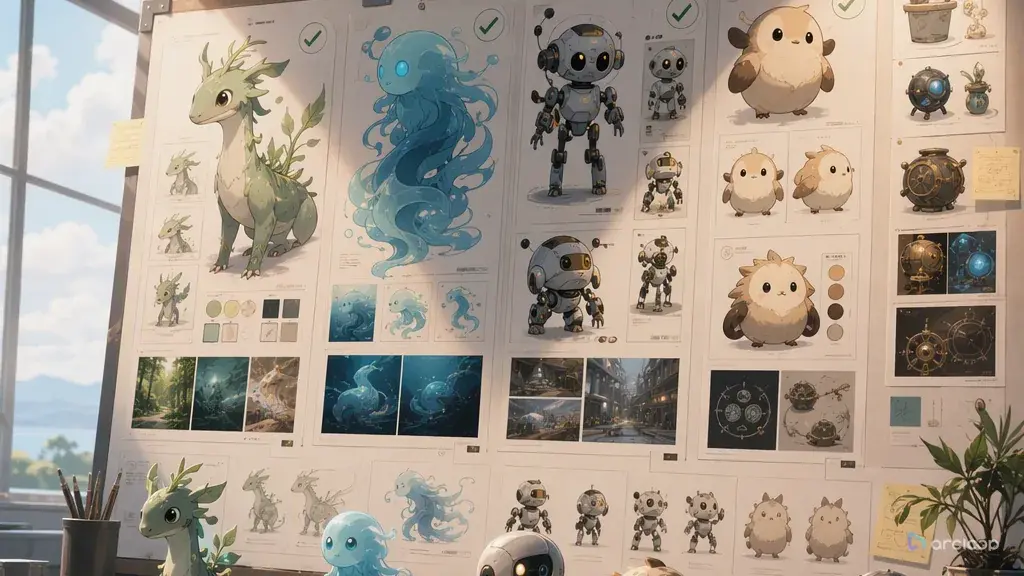
Sheet requirements: front view, side view, top fold view, five expression states, scale comparison beside a teacup, clean cel-shaded anime finish.
Negative constraints: do not add human hands, feet, hair, lips, nose, clothes, wings, or a full mascot body; no fake readable text, no logos, no copied character design.
This character sheet protects the body logic before any story scene is generated. Quillbit can be expressive, but it cannot become a small human in a paper costume.
Example 2: Quillbit finds the missing index card
Generate a 6-second 2D anime shot using the approved Quillbit character sheet.

Scene: after closing time in a moonlit library, Quillbit floats above a wooden catalog drawer, notices one misplaced blank index card, and nudges it back into place with a bookmark-ribbon arm.
Camera: locked medium close-up from desk height, catalog drawer in the lower half, Quillbit centered, moonlit shelves softly blurred behind.
Character anchors: triangular folded cream paper body, two bookmark-ribbon arms, tassel tail, ink-dot eyes, blue stamp on back fold, no legs, no fingers, no human face.
Motion: Quillbit hovers, tilts left in surprise, folds tighter for one beat, then extends one ribbon arm to push the card into the drawer.
Style: clean 2D anime, warm paper texture, cool moonlight, soft shelf shadows, quiet magical library mood.
Readability rules: keep the blank index card readable; show emotion through fold and tilt only.
Negative constraints: no mouth, no eyebrows, no human hands, no extra limbs, no fake text on cards, no costume, no photorealistic paper, no watermark.
The shot uses emotion and action without breaking the anatomy. A simple object interaction is enough to prove the character can work in a scene.
Example 3: Rooko tide-pool courier motion test
Create a 7-second 2D anime motion test for Rooko, an original nonhuman tide-pool courier machine.

Design anchors: Rooko has a round blue ceramic shell body, four short brass crab-like legs, one glass lens eye, a wind-up key on the back, and a tiny cargo tray sealed with red wax. It is mechanical, not an animal and not a human.
Scene: Rooko crosses a shallow tide pool at sunset to deliver the tray to a stone marker. Small water ripples follow each brass foot.
Camera: low side view, full body visible, locked camera, stone marker on frame right.
Motion rule: skitter in four careful steps, pause, lens eye narrows by shutter blades, wind-up key rotates once, then tray lid clicks open slightly.
Material behavior: ceramic shell catches orange rim light, brass legs reflect water, glass lens glints once, wax seal stays red.
Expression: personality comes from timing, lens shutter, and hesitant foot placement, not a mouth or eyebrows.
Negative constraints: no human face, no arms, no fingers, no fur, no extra legs, no costume, no speech bubble, no logo, no text, no photorealism.
This example shows how a robot-like nonhuman can feel alive through material, timing, and mechanical gestures rather than human features.
The ways nonhuman designs collapse
The biggest mistake is writing "nonhuman" but describing a human body with accessories. Animal ears or a tail do not change the anatomy by themselves.
Another mistake is adding too many expressive systems. Pick the body parts that carry emotion.
Creators also forget material limits. Paper should fold and flutter, not stretch like rubber. Ceramic can chip or glint, not squash like a plush toy. A machine can hinge, slide, and click, but it should not grow new joints between shots.
A fourth mistake is changing anatomy during revisions. If the idle pose has no fingers, the action shot should solve interaction another way.
Finally, do not use famous creatures, mascot shapes, game monsters, or brand-like sidekicks as shortcuts. Build the species logic from original silhouette, material, motion, and story role.
FAQ
How do I make a nonhuman character expressive without a human face?
Use body language tied to the material: folding, tilting, glowing, pulsing, skittering, rattling, shrinking, expanding, or changing posture. Expression does not need eyebrows and lips if the movement is readable.
Should nonhuman characters have voice lines?
Only if the story needs them. Some work better with rustles, clicks, chimes, or glow pulses. When they do speak, set the voice on the character asset so the performance matches the body and scene timing.
What should a nonhuman character sheet include?
Include front and side views, scale, eye or sensor design, material notes, movement states, expression states, and forbidden human additions. For recurring characters, add a simple interaction pose with a human or prop.
How can I stop AI from turning a creature into a mascot child?
Write the anatomy rule clearly and repeat it in every shot: no human face, no fingers, no hair, no clothing, or whatever applies. When a shot breaks the rule, regenerate just that shot — the asset's reject list did not change, only that one take was wrong.