
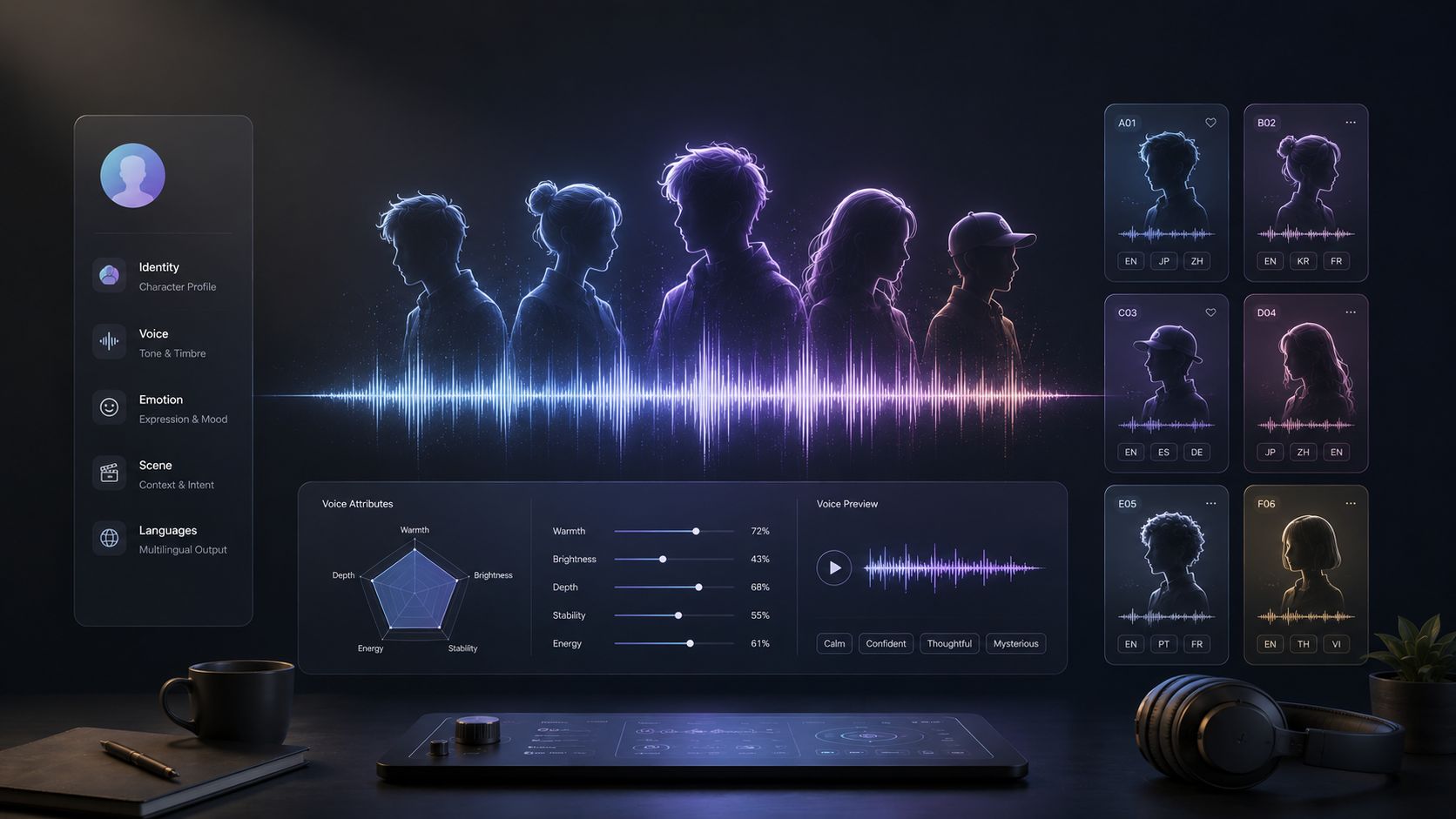
A character can whisper in one scene and argue in the next while still sounding like the same person. A useful character voice template keeps that recognizable voice separate from the way each line is performed.
Below are 20 editable AI character voice cards with audio previews. Choose a close starting point, replace the dialogue, and check it against your own script before using it throughout a series.
What to keep fixed in a character voice card
Split the card into three layers so a scene change does not become a change of actor.
| Layer | What to record | When to change it |
|---|---|---|
| Voice identity | Perceived age, register, texture, language and intended accent; saved voice or reference asset | Keep the approved base for the same character; test again after a language, model, or voice change |
| Performance | Listener, acting goal, emotion, pace, pauses, breath and sentence endings | Adjust for each scene |
| Mix | Phone filtering, room reverb, distance effects and background sound | Adjust for the recording space or edit |
Choose a few audible traits: a warm low register, a faint rasp, precise diction. Then give the scene a specific action. “Trying to reassure a friend without showing how tired he is” gives you something to direct; a string of adjectives gives you less to compare between takes.
A character's job or social position can suggest a performance choice, but it does not determine their voice. Decide how this person addresses this listener. Put temporary exhaustion or whispering in the performance layer. Keep an enduring texture in the identity layer only if it belongs in the character's usual voice.
A copyable character voice prompt template
Use this full card to turn a short example into a production note. The field names organize your directions; they are not special model commands. Put the dialogue in the tool's text field and map the other notes to the controls it supports.
[Character] Ethan Cole. He is comforting someone who is frightened.
[Identity] Male, late 30s; warm low baritone with a faint rasp.
[Language / accent] English. Choose the intended accent for this production.
[Voice source] Record the saved voice ID/name, or the approved reference file.
[Performance] Tired but steady. Speak slowly, leave room for a reply, and keep the volume low.
[Scene] Speaking directly to the frightened person; the aim is to help them breathe calmly.
[Mix] Keep a clean dialogue version; record any effects separately.
[Line] Hey… look at me. You're okay. I've got you — just breathe with me, alright?
[Record] Model/version, available settings, card revision and accepted take.
For another scene, keep the approved voice source and identity, then change the performance and line. If the tool does not expose a voice ID, record the voice selection or reference file, model, and available settings. Reusing the same description alone does not guarantee the same voice.
You can try your revised dialogue in the AI Character Voice Generator, then keep the accepted voice and take with the character's notes.
20 editable AI character voice templates and audio examples
These cards reorganize the voice descriptions, performance notes and original lines from the existing Seed Audio examples. Each preview sits with its copyable card. The performance describes that example; change it when your scene calls for a different reading.
| Templates | Audio language | Starting points |
|---|---|---|
| 01–10 | English | Reassurance, smoky delivery, nervous energy, restraint and authority |
| 11–14 | Korean | Patient conversation, teasing, restrained affection and quiet reassurance |
| 15–18 | Japanese | Fragile delivery, whispering, bright energy and careful speech |
| 19–20 | Brazilian Portuguese | Playful warmth and patient encouragement |
The spoken lines remain in their original languages. Translating a card does not create a new audio version; this set contains no Chinese-language preview. The examples show possible directions, rather than a rule for how characters in a language should sound.
Choose a card by its base voice, then listen for pauses, emphasis and emotional delivery. Replace the original line with your own before deciding it fits. These are starting templates, not evidence that a voice will remain consistent across every scene or language.
01 Ethan Cole
[Identity] Male, late 30s; warm low baritone, faint rasp.
[Performance] Slow and steady despite exhaustion; long pauses, low volume.
[Audio language] English
[Line] Hey… look at me. You're okay. I've got you — just breathe with me, alright?
English audio · Original example
02 Mara Whitfield
[Identity] Female; smoky alto, breathy texture.
[Performance] Languid pace, trailing endings, a knowing half-smile.
[Audio language] English
[Line] Play it again, sugar… slow. We've got nowhere to be but here.
English audio · Original example
03 Ollie Finch
[Identity] Male, early 20s; light, bright voice.
[Performance] Fast and upbeat; stumbles when flustered, with small breathy laughs.
[Audio language] English
[Line] Oh—oh gosh, sorry, one oat latte, extra hot—careful, it's, um, really hot!
English audio · Original example
04 Ray Kowalski
[Identity] Male, 50s; low and gravelly.
[Performance] Terse phrases and long silences; each word takes effort.
[Audio language] English
[Line] Thirty years on the job. People lie. The scene doesn't.
English audio · Original example
05 Isabelle Hart
[Identity] Female; crisp, cool voice with precise diction.
[Performance] Composed and polite; holds emotion back, turns cold when challenged.
[Audio language] English
[Line] I'll give you that one step. But don't test me on the next.
English audio · Original example
06 Sam
[Identity] Male; warm, bright voice.
[Performance] Quick and open, with easy laughter and an encouraging tone.
[Audio language] English
[Line] Okay, okay—hear me out. This is the best worst idea we've ever had. Let's go.
English audio · Original example
07 Vivienne Cross
[Identity] Female; cool voice.
[Performance] Controlled and commanding; measured, clipped phrases, a threat beneath the courtesy.
[Audio language] English
[Line] You have my attention for ninety seconds. Do not waste it.
English audio · Original example
08 Grandpa Joe
[Identity] Male, 60s to 70s; soft, warm voice.
[Performance] Unhurried and fond, slightly rambling, with a smile in the voice.
[Audio language] English
[Line] Time's a funny thing, kiddo. Slow it down enough… and it starts to feel like plenty.
English audio · Original example
09 Nadia
[Identity] Female; gentle, breathy voice.
[Performance] Quiet and hesitant, as if apologizing for the interruption.
[Audio language] English
[Line] Um… it's due back Thursday. But… take your time. I don't mind.
English audio · Original example
10 Marcus Vane
[Identity] Male; low voice.
[Performance] Soft, even and unhurried; a hint of a smile beneath the threat.
[Audio language] English
[Line] Sit. Please. We both know you're not leaving until I've finished talking.
English audio · Original example
11 Seojun
[Identity] Male, 30s; low, gentle voice.
[Performance] Calm, clear and patient; brief pauses to think.
[Audio language] Korean
[Line] 천천히 대답해도 돼요. …그냥, 아무도 그렇게 물어봐 주지 않았을 뿐이니까.
Korean audio · Original example
12 Haeun
[Identity] Female; sweet, soft voice with a slight nasal tone.
[Performance] Playful and coaxing; stretch the rising endings, with teasing back-and-forth.
[Audio language] Korean
[Line] 가지 마… 딱 오 분만. 응? 오 분만 더 있으면 안 돼…?
Korean audio · Original example
13 Dohyun
[Identity] Male; low voice with little pitch variation.
[Performance] Short, clipped phrases; affection emerges late and reluctantly.
[Audio language] Korean
[Line] …춥잖아. 이거 입어. 딴 뜻 없으니까 오해하지 말고.
Korean audio · Original example
14 Jiwoo
[Identity] Female; low, breathy voice.
[Performance] Very slow and soft, with long silences, as if whispering nearby.
[Audio language] Korean
[Line] 오늘도 수고했어요. …이제, 아무것도 안 해도 되는 시간이에요.
Korean audio · Original example
15 Todo Ren
[Identity] Male; low, raspy, breathy voice.
[Performance] Very slow, with long pauses and trembling endings; fragile beneath a tough front.
[Audio language] Japanese
[Line] 泣くなよ……らしくない。ほら、もう少しだけ、そばにいろ。
Japanese audio · Original example
16 Shirase Misaki
[Identity] Female, late 20s; low voice with a breathy texture.
[Performance] Whisper throughout, with generous pauses and a close-to-the-ear delivery.
[Audio language] Japanese
[Line] 今日も一日、おつかれさま。……もう、何も頑張らなくていいからね。
Japanese audio · Original example
17 Hinata Taichi
[Identity] Male, late teens; bright, clear voice.
[Performance] Fast and bouncy, with rising endings and frequent laughter.
[Audio language] Japanese
[Line] おい見ろよ、あの夕焼け!……急げ急げ、消えちまう前に!
Japanese audio · Original example
18 Yukimura Kaoru
[Identity] Androgynous; soft, calm voice.
[Performance] Quiet, polite and slow; slightly shy, choosing words carefully.
[Audio language] Japanese
[Line] 返却は木曜まで……あ、でも、ゆっくりで大丈夫ですよ。
Japanese audio · Original example
19 Rafael Duarte
[Identity] Male; warm, slightly husky voice.
[Performance] Playful and charming, with a lilting rhythm and a smile in the voice.
[Audio language] Brazilian Portuguese
[Line] Calma, meu anjo… senta aqui. Com você por perto, o dia todo fica melhor.
Brazilian Portuguese audio · Original example
20 Helena Marques
[Identity] Female; soft, warm voice.
[Performance] Slow, patient and welcoming; keep the volume gentle.
[Audio language] Brazilian Portuguese
[Line] Respira fundo. Errar faz parte… a gente aprende junto, no seu tempo.
Brazilian Portuguese audio · Original example
Test a character voice with new dialogue
A preview tells you how a voice handles that particular text. Before assigning it to a recurring character, try four different passages from the project. Use the same saved voice or reference and keep the other settings steady while comparing takes.
| Test | What to try | What to listen for |
|---|---|---|
| Neutral statement | An ordinary line without a strong emotion | The baseline register, texture and pronunciation |
| Quiet line | A line spoken softly to someone nearby | Lower volume without losing the recognizable voice |
| Argument | A tense exchange with one clear acting goal | Emotion changes while the speaker remains recognizable |
| Real script passage | A longer passage within the model's text limit | Natural pacing, names, omitted words and identity drift over time |
Judge identity and performance separately. If the person sounds right but the emotion does not, adjust the performance first. If the voice itself changes, check the saved selection, reference, language and model before adding more adjectives. Keep the accepted takes and useful failures for comparison. This is a suggested audition process; the 20 previews have not been tested through it here.
Record the model/version and settings the tool actually exposes. A seed, when available, can help control a comparison; it is not a voice identity lock.
Fix voice drift, repeated lines and awkward joins
Change one cause at a time so the next take tells you something useful.
| Problem | Check first | Next adjustment |
|---|---|---|
| The character sounds like someone else | Saved voice, reference, model/version and language | Restore the approved source; compare the same neutral line |
| The voice fits, but the acting does not | Conflicting emotion, pace or breath directions | Give the line one acting goal and revise the performance layer |
| The output repeats the reference dialogue | Whether the audio is being copied or used as a voice reference; the target text | Select the intended reference role and supply the new dialogue separately |
| Two characters share or swap voices | Speaker names/IDs and their assigned audio sources | Keep a clear speaker-to-voice mapping using the model's supported format |
| Short clips join badly, or a long passage drifts | Text length, emotional transitions and surrounding context | Compare a complete passage with a split at a natural thought or speaker boundary |
If you use MiniMax H3's native full-reference workflow, its guide distinguishes reference, which does not directly copy the audio signal, from fully_copy, which reuses the complete source as the final audio track. State whether you want timbre, delivery or dialogue content from the reference. Those labels belong to that workflow; use the reference controls supported by your own tool.
For a misread word, retrying one line may be enough. For an exchange that depends on the previous speaker, compare a longer passage with separate turns, within the model's limits. Shorter clips are easier to replace, but they can introduce changes in rhythm or voice at the joins. Choose by the failure you hear.
Character voice template FAQ
Why does the saved voice sound different from its preview?
The new text may call for different pacing or emotion, or the selected voice, reference, model or settings may have changed. Compare a neutral line with the same source and settings first, then add the scene's performance direction. A good preview alone cannot establish consistency on a whole script.
Can I reuse a character voice card in another language?
Keep the character's identity notes as a target, then set the new language and intended accent explicitly. Check pronunciation, names, sentence endings and emotional delivery with new lines. Whether the voice stays recognizable depends on the selected model and voice; translating the card does not establish that it works. The previews above remain English, Korean, Japanese and Brazilian Portuguese audio.
Can I paste the whole card into any text-to-speech model?
Use it as a set of production notes. Some tools separate dialogue, voice selection and delivery instructions; others expose fewer controls. Map each field to the supported input, and keep unsupported notes in your project record. Do not assume the tool will interpret every label or avoid reading instructions aloud when they are pasted into the dialogue field.