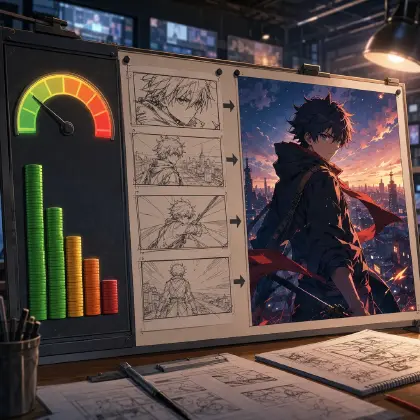


Where the money actually disappears
A lot of people assume AI short drama is cheap, then finish an episode and find the money went somewhere invisible: the character was never built as an asset, so every shot describes the face and outfit from scratch, breaks the moment the shot changes, and gets rerun a dozen times; multi-character blocking was written vaguely, shots don't line up, and the whole thing gets redone; the voice was never bound to the character asset, the voiceover doesn't sound like the same person, and it gets re-recorded — none of this shows up until the edit. A single generation isn't expensive; random regeneration is the real cost sink. Build any character that recurs as an asset in My Assets first, reference it into shots with @, and that alone cuts most of the reruns.
Cost control isn't about spending less across the board — it's about spending on things that get reused. Break down the script and shots in the workspace, manage the finished structure with the AI short drama guide, and manage reuse with the character asset guide. That's what lets you tell whether an episode is ready for paid testing, a compilation, or a long-term character IP.
The cost buckets and the one lever that matters
AI short drama cost breaks into six buckets: concept and script cost, character asset cost, storyboard cost, video generation cost, voiceover cost, and edit/rework cost. A lot of creators only look at video generation cost and ignore rework. In practice, any face change across shots, mismatched lip sync, or lighting jump wastes everything spent generating the earlier shots.
The core lever is reuse rate. A character asset carries over across episodes, a lighting spec carries over across scenes, a storyboard pattern carries over across genres, and a character voice carries over across episodes. The higher the reuse rate, the cheaper it gets to produce at volume. Redesign the character, rewrite the prompt, and re-record the voice every single episode, and cost spirals fast. Character asset investment should also be layered: the base character asset is cheapest, a reference images (multiple angles) improves angle stability, a character asset with reference images makes review easier, and the character asset with bound reference images is the long-term reuse center. Think of it as building an identity record for the system — look, color palette, props, and voice get locked in first, then get called on by reference later.
Don't price a single episode against an external rate card — use a structured order-of-magnitude framework instead. The first cost bucket is material cost: character assets, reference images (multiple angles), character asset with reference images, scene images, shot videos, voiceover, subtitles, cover. The second cost bucket is rerun cost: how many reruns went to character drift, blocking chaos in a shared shot, bad lip sync, lighting jumps, and failed actions. The third cost bucket is time cost: script breakdown, storyboard review, material selection, edit assembly, rework coordination, and the pre-publish check. What determines whether an episode is worth it is the stable output rate across all three ledgers together, not how cheap one lucky generation looked.
The full pipeline is still concept → script → storyboard → video → voiceover → edit, and the budget should be built the same way. Manage the finished cut with the AI short drama guide, manage reuse with the character asset guide, manage shot count with storyboard templates, and manage voice with voiceover tools.
How to run a shoot without blowing the budget
Step 1: set a cost ceiling for the project. Decide up front how many shots an episode gets, how many reruns per shot, how many voiceover passes, and how many hours of editing. Without a ceiling, "just one more try" will eat the whole budget. Set pacing ceilings too: a publishable mini-arc needs to land within 15 seconds, and anything past 30 seconds gets budgeted by segment, so one oversized take doesn't burn the whole episode's trial-and-error allowance.
Step 2: spend first on the lead's character asset. The lead's main image, turnaround, expression set, and character voice are worth the investment because they show up across every episode. Low-frequency supporting characters can stay simple.
Step 3: control shot count. More shots isn't automatically better. Every shot needs to serve the hook, the conflict, the twist, or the next-episode payoff. Cut any informational shot that doesn't.
Step 4: set rerun rules. For example: a broken face on a character must be redone; a minor background flaw can be fixed in editing; a non-critical lighting mismatch can be color-corrected. Without rules, the team ends up rerunning every small issue.
Step 5: generate low-cost previews first. Use lower settings to test blocking, action, and pacing, then move to high-quality output once it passes. This matters especially for multi-character shots and lip sync — don't jump straight to final quality.
Step 6: manage voiceover on separate tracks. If multi-character voiceover is mixed together, later fixes get expensive. Separate tracks let you fix one character without re-recording the whole segment.
Step 7: run a commercial review. After each episode, log cost, rerun causes, reused material, the completion-rate hook, and the next-episode payoff. Reusable material goes into the My Assets; non-reusable lessons go into a pitfalls list.
Before you start generating, spend five minutes setting up the assets that will carry the whole series.
Open your IP Project at /creative/worlds and go to My Assets. Create a Character asset for your lead — give it a name, then go to your Library (Images tab) and upload the main image you have. Click Bind on that image and set it as Main image. If you have a side-angle or expression reference, bind those as Reference images on the same asset. Do this once; every episode reuses it.
Now open Episode 1 and click Generate Shots. The storyboard fills in automatically. Open any shot card and type @ followed by your character's name — select them from the dropdown. Your shot description now only needs to say what happens in this shot: the action, the camera angle, the light. You don't need to describe the face or outfit — that's already in the asset.
Once the shot descriptions look right, generate images first to confirm framing and character consistency. Only move to video after the image passes. For multi-character shots or any shot with lip sync, use the AI Chat Panel to batch-trigger: Generate videos for Shots 3, 4, and 5. — this keeps you from running each shot manually and lets you review them as a group.
When all shots for the episode are done, head to Edit, arrange the clips on the timeline, and use Generate Voiceover per character on separate passes so each voice track stays editable independently.
Prompt and spec examples to copy
Example 1: Per-Episode Budget Table
Build a per-episode budget table for a 60-second vertical short drama. The lead character is @Mei Lin, a convenience store clerk. Fields: storyboard shot count, rerun cap per shot, voiceover passes, edit hours, total material cost, rerun cost, time cost. Break down by stage: concept → script → storyboard → video → voiceover → edit. Flag the rerun triggers most likely to blow the budget: @Mei Lin's face shifting between shots, blocking mismatches in the rooftop confrontation scene, and lip sync on the climax line. Output as a three-column table: material cost / rerun cost / time cost.
Example 2: Rerun Decision Rules
Write rerun decision rules for a short drama episode featuring @Jae-won and @Soo-ah. Must redo: face shape change on either character between shots, @Jae-won's key prop — the crumpled letter — missing from frame, mismatched lip sync on any dialogue shot. Fix in editing: minor background blur, brief hand artifact on a non-dialogue shot, slight color temperature shift in a background scene. Accept as-is: edge details in wide shots that don't affect story comprehension. Mark commercial priority: the opening hook shot, the corridor confrontation between @Jae-won and @Soo-ah, and the final close-up on the letter.
Example 3: Batch Production Cost Review
Run a batch cost review for 10 episodes of a short drama series centered on @Lin Xia. Report: average shot count per episode, average reruns per shot, @Lin Xia character asset reuse rate across episodes, scene asset reuse rate for the apartment and rooftop locations, character voice reuse rate, top three rerun causes, and the single cheapest-to-reuse asset. Recommend for the next batch: which reference images need to be added to @Lin Xia's asset, which storyboard patterns repeated across episodes can be templated, and which shot types drove the most reruns. Conclude with a commercial readiness verdict: suitable for a compilation release, paid commissions, or concept testing only.
What causes cost overruns — and how to fix them
The first failure mode is only counting generation cost. The fix is putting script, storyboard, voiceover, editing, and reruns all into the budget.
The second failure mode is skipping the character asset to save money. It's cheap short-term and the most expensive long-term. Without a main image and turnaround, everything downstream keeps getting rerun.
The third failure mode is redoing every single issue. The fix is tiering: must redo, fixable in editing, acceptable as-is. Save the budget for the shots that matter.
The fourth failure mode is too many multi-character shots. Shared shots with multiple characters cost more and go wrong more easily — unless it's a conflict highlight, break it into single-character reactions and prop close-ups instead.
The fifth failure mode is skipping the review. Commercial success isn't just about views — it's also about per-episode cost, reuse rate, and whether the next episode comes together faster.
FAQ
Where should AI short drama cost cutting start?
Cut non-critical shot count and excess reruns first — don't cut the lead's character asset. The more stable the lead's asset, the cheaper everything downstream gets.
Do you need a character asset with bound reference images from day one?
Build a minimum-viable asset for the lead: main image, turnaround, expression set, character voice. Other characters can be tiered by how often they appear.
Does cost control hurt quality?
Good cost control improves quality, because it concentrates the budget on characters, conflict, covers, and twist shots, and cuts down on wasted reruns.