

What the 15-second cap actually means
MiniMax H3 generates up to 15 seconds per clip, and the moment anyone tries to make something longer, they meet the search term "minimax h3 loop." It points at a real technique: context-loop clip chaining, a community approach — packaged as nodes for graph-based tools — that feeds the end of one H3 clip into the start of the next so motion and audio genuinely continue across the join.
It works, and it is one of three ways past the cap. The other two are the model's own audio-video continuation mode and the oldest technique in animation: cutting. Which one you want depends on what the sequence is. This guide lays out all three, with the anime-specific reasons to choose each.
Option 1: Audio-video continuation (built in)
H3's hosted API can extend an existing clip, continuing both the picture and the sound. You hand it the clip and a description of what happens next; it produces the following seconds with the same subject, lighting, and audio bed.
Best for: a single held performance that must not break — a sung phrase running 20 seconds, a slow dolly toward a face, a dance move that crosses the 15-second line.
Watch for: drift accumulates. Each continuation is a new generation conditioned on the last one; by the third extension, small changes in the face or palette have compounded. Two extensions is the practical limit for identity-critical shots, and a reference image of the character in every extension request helps hold the line.
Option 2: Context-loop chaining (community)
The chaining technique behind the "loop" searches goes further than continuation. Rather than re-describing the handoff, it carries the model's internal state — the tail of the previous clip's latent and audio — into the next generation, so the join is not a reconstruction. The better implementations slice the pinned frames straight out of the latent instead of decoding to pixels and re-encoding, which is what removed the visible seam earlier attempts had.
Best for: technical users running the open weights who need long continuous takes — ambient loops, a continuous camera drift, background motion for a scene.
Watch for: it is a self-hosted, graph-based workflow at 768p (the open weights have no 2K stage), and it needs hardware. For a creator who wants clips rather than pipelines, this is the road you read about, not the one you take. And it inherits continuation's drift problem across many links — the sequence stays smooth, but the character may not stay the same.
Option 3: Cut it like anime (the storyboard method)
Here is the thing most "how do I make it longer" searches skip: anime is not made of long continuous takes. A typical scene cuts every two to eight seconds — close-up, reaction, wide, insert. The 15-second window is not a wall in front of an anime scene; it is bigger than almost any single shot in one.
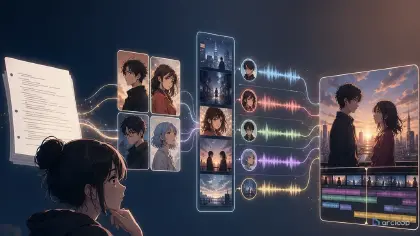
So the method that produces the most anime-looking result is also the one that sidesteps the cap entirely: break the scene into shots, generate each shot as its own clip, and assemble them.
Best for: narrative scenes, dialogue, action, anything with more than one beat — which is nearly everything.
Why it beats chaining for character work: every shot starts from the same character references rather than from the previous clip's drift. Ten shots stay as on-model as one. And every cut is a place to change camera, size, and rhythm, which is what makes a sequence feel directed instead of generated.
Watch for: continuity between shots is now your job — lighting direction, costume state, eyeline, where the character stands. The storyboard continuity guide covers the checks.
The storyboard method, step by step in ArcLoop
- Write the scene as beats, not as one description. "She enters. She sees the letter. She reads it. She looks up." Four beats, four shots.
- Open the Episode and hit Generate Shots. The storyboard breaks the scene into shot cards. Adjust durations per card — 4 seconds for the reaction, 8 for the read.
- Reference the cast with
@on every card.@Yuion each shot means each one reads the same bound Main image and Reference images. Identity does not depend on the previous clip. - Describe only what changes per shot. Camera, action, light. Keep lighting direction and time of day consistent across cards — write "same afternoon light" once per card if the model needs the nudge.
- Generate stills for the whole sequence first. Ten stills cost less than one bad video, and they show continuity problems — a lamp that moved, a jacket that changed — side by side on the storyboard.
- Generate videos, batch them from the AI Chat Panel — "Generate videos for Shots 1 through 4." — and pull them onto the Edit timeline. Trim, reorder, replace the shot that missed. The sequence's total length is whatever the timeline says, with no join ever crossing the 15-second cap.
- Use continuation only where a cut would hurt. The one sung line, the one slow push-in — extend that shot alone.
Choosing between the three
| Sequence | Method |
|---|---|
| A 20–25 s single performance (song, speech, dance) | Continuation, one or two extensions, with a character reference |
| Ambient or looping background, self-hosted | Context-loop chaining |
| A narrative scene with several beats | Storyboard method: cut into shots |
| Dialogue between two characters | Storyboard method: alternating shots |
| A music video | Storyboard cut to the beat; continuation only for a held vocal |
| Anything where the face must be identical for a minute | Storyboard method — every shot restarts from the references |
Ways this goes wrong
- Chaining a narrative scene. Smooth joins on a scene that should have cut reads as a screensaver, not a story.
- Extending past two links on a character shot. Drift compounds; the third extension is where the face goes.
- Skipping stills before a long sequence. Continuity problems are cheap to find on a storyboard and expensive to find in ten rendered clips.
- Forgetting the sound at the joins. H3 generates audio per clip; on the timeline, let the ambience overlap slightly or add a bed so cuts do not click.
FAQ
What does "minimax h3 loop" mean?
Context-loop clip chaining — a community technique that carries H3's internal state from one clip into the next so motion and audio continue across the join. It is a self-hosted workflow, distinct from the model's built-in continuation mode.
Can MiniMax H3 make a one-minute video?
Not in one generation; the cap is 15 seconds. A one-minute anime sequence is normally 8–15 shots generated separately and assembled — the storyboard method above.
Does continuation keep the character consistent?
For one or two extensions, mostly. Beyond that, drift compounds. Restarting each shot from bound references is more reliable for identity-critical work.
Is there a way to do this without self-hosting?
Yes — the storyboard method needs no pipeline. In ArcLoop, shots are generated on hosted H3 (with the 2K stage) and assembled on the Edit timeline.
Cut first, chain last
The 15-second cap is a real limit on a generation and almost never a limit on a scene. Plan the scene as shots, keep the cast anchored in assets, generate stills before video, and reach for continuation only where a cut would break a performance. Open your project, write the beats, and let the storyboard turn the cap into a cutting rhythm.