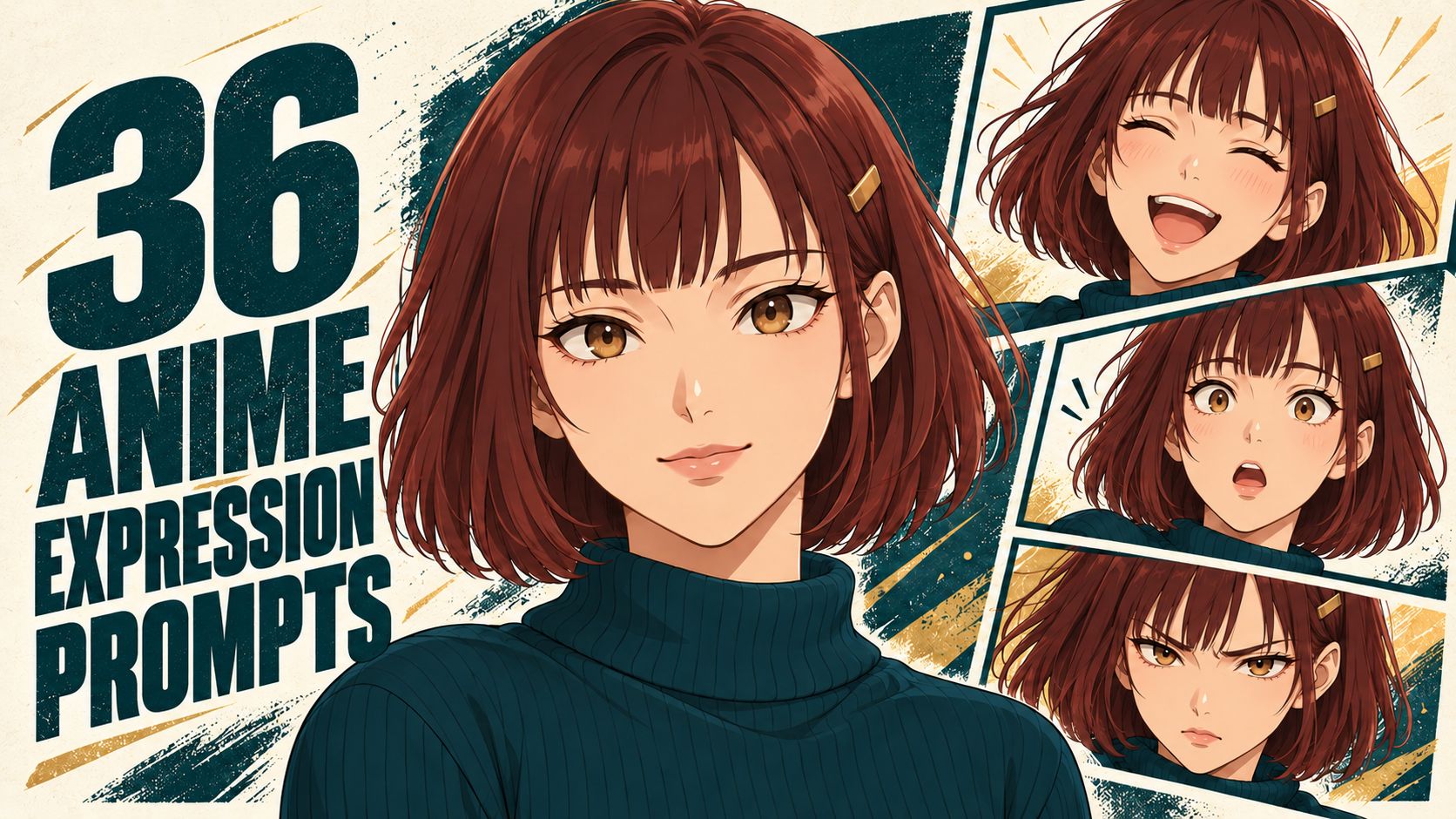
To prompt an anime facial expression, name the reaction, describe the visible changes in the brows, eyes and mouth, and hold the character reference steady. A few clear cues beat a long list of emotions.
Below are 36 prompt entries with matching numbered examples: 27 facial reactions and nine stylized anime effects. All four sheets use Rina, the same original adult character. The panel instructions in the tables are copied verbatim from the submitted generation prompts. Each sheet was one nine-panel generation — not 36 separate tests.
Start with one character reference
Rina is an original 26-year-old anime woman: dark auburn bob, amber eyes, a small brass clip above her left temple, a dark teal high-neck sweater. Her left-side clip appears on the viewer's right.
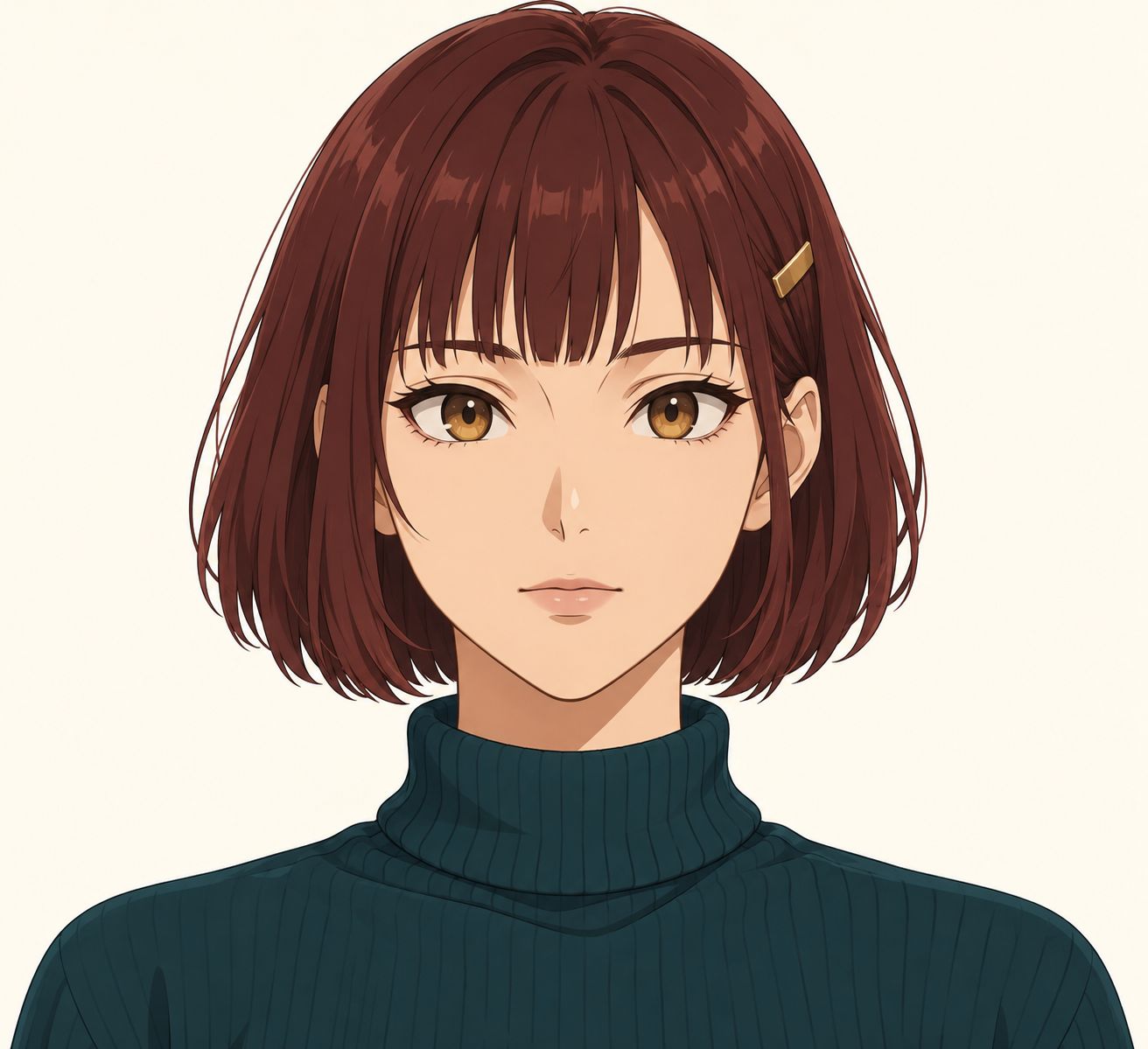
Upload the approved portrait as the reference for every request. Keep hairstyle, face shape, outfit, lighting and portrait scale fixed. The expression should do most of the changing.
Try this with a reference-based workflow in GPT Image 2.5 on Arcloop. The portrait has to go in through the image-input control — typing a character name does not attach a reference. These illustrations demonstrate a workflow, not a benchmark between named models.
How the prompts match the pictures
Read each sheet left to right, top to bottom. Numbers 01–09 are sheet one, 10–18 sheet two, 19–27 sheet three, and 28–36 sheet four.
The table entries are the unchanged expression instructions submitted for those panels. Every request also carried the reference image plus shared instructions for a three-by-three grid, character consistency, upright heads, front-facing portraits, ivory backgrounds and numeric labels.
That tells you which input produced which sheet. It does not mean the model obeyed every cue — judge the image against the instruction, and don't quietly rewrite the instruction afterward to fit the result.
Sheet 1: Nine core facial expressions
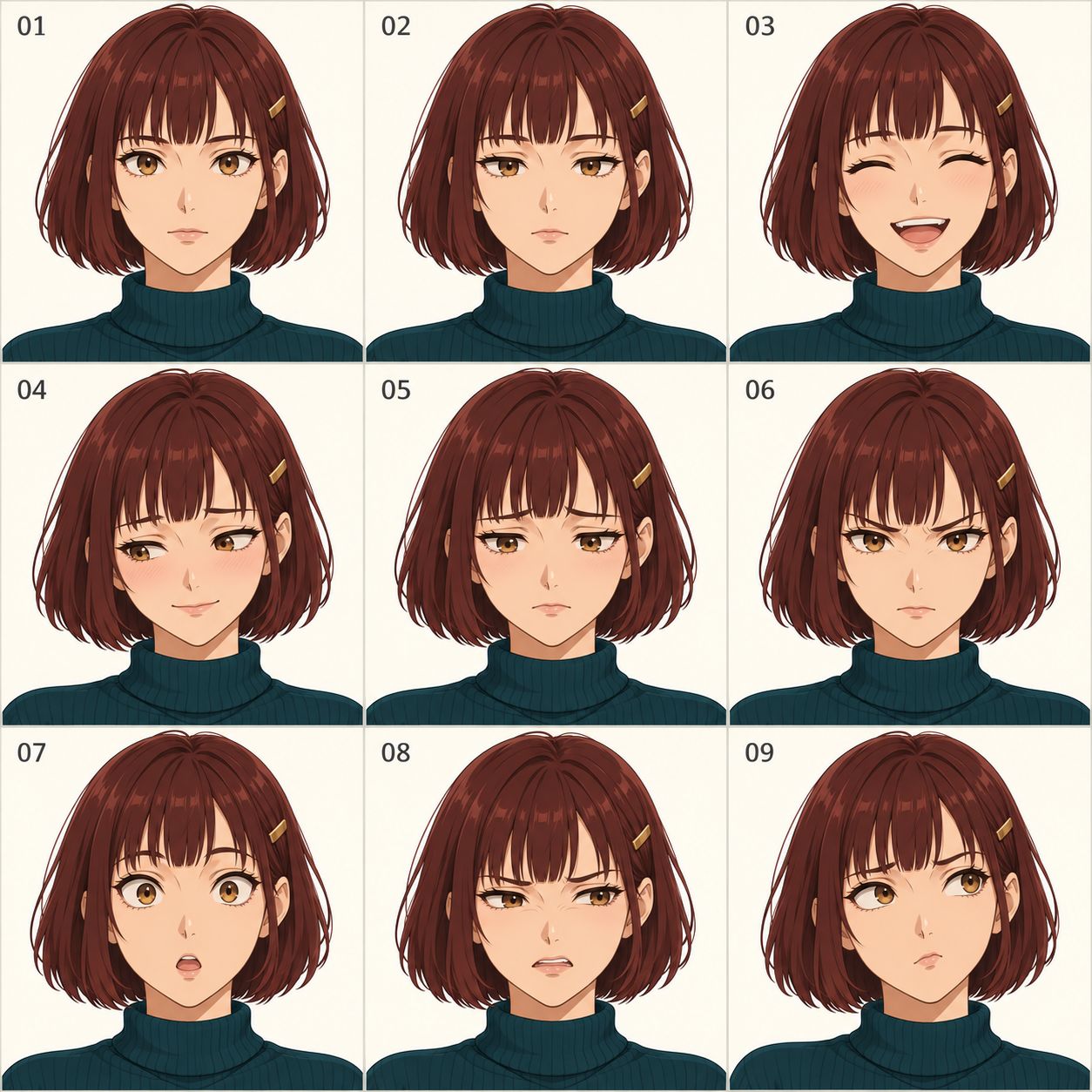
| Panel | Expression | Exact expression instruction submitted |
|---|---|---|
| 01 | Neutral | Relaxed level brows; naturally open eyes looking straight ahead; lips gently closed with no smile or frown; relaxed cheeks. |
| 02 | Deadpan | Level relaxed brows; upper eyelids visibly lower than neutral while the gaze stays attentive and forward; mouth a straight closed line; no smile, sad brow, or angry brow. |
| 03 | Joy | Relaxed slightly raised brows; both eyes narrowed into cheerful crescents by lifted cheeks; a broad open-mouth smile with upper teeth visible; clear joyful amusement. |
| 04 | Shy smile | Inner brows gently raised; eyes glance down to her right without turning the head; a small closed-mouth smile; a restrained rosy blush on both cheeks; no tears. |
| 05 | Sadness | Inner brows lifted and drawn together; eyes looking slightly down with glossy lower eyelids; lips closed with both corners down; no falling tears and no open-mouth sob. |
| 06 | Anger | Brows clearly drawn inward and down; eyes narrowed into a focused forward glare; lips firmly pressed into a closed tense line; no smile, teeth, or open mouth. |
| 07 | Surprise | Brows clearly raised; eyes wide with smaller visible pupils; lips form a small round open mouth; no tears, screaming, or comic symbols. |
| 08 | Disgust | Nose visibly wrinkled; upper lip raised; brows lowered; eyes mildly narrowed; mouth slightly open with corners down; show aversion rather than a smile or angry shout. |
| 09 | Confusion | One brow raised and the other lightly knitted; eyes looking slightly upward to her left without turning the head; lips gently pursed to one side; no smile, blush, tears, or comic symbols. |
What to compare: deadpan keeps an attentive gaze under lowered lids; anger adds inward brow tension; disgust adds nose and upper-lip cues. Those directions are what stop three different reactions from collapsing into the same frown.
Observed limits: the shy and confused portraits tilt their heads despite the shared upright-head instruction. The shy smile still reads clearly — the pose just isn't what was asked for. Keep that distinction if you use the sheet as an example.
Sheet 2: Subtle reactions and controlled emotion
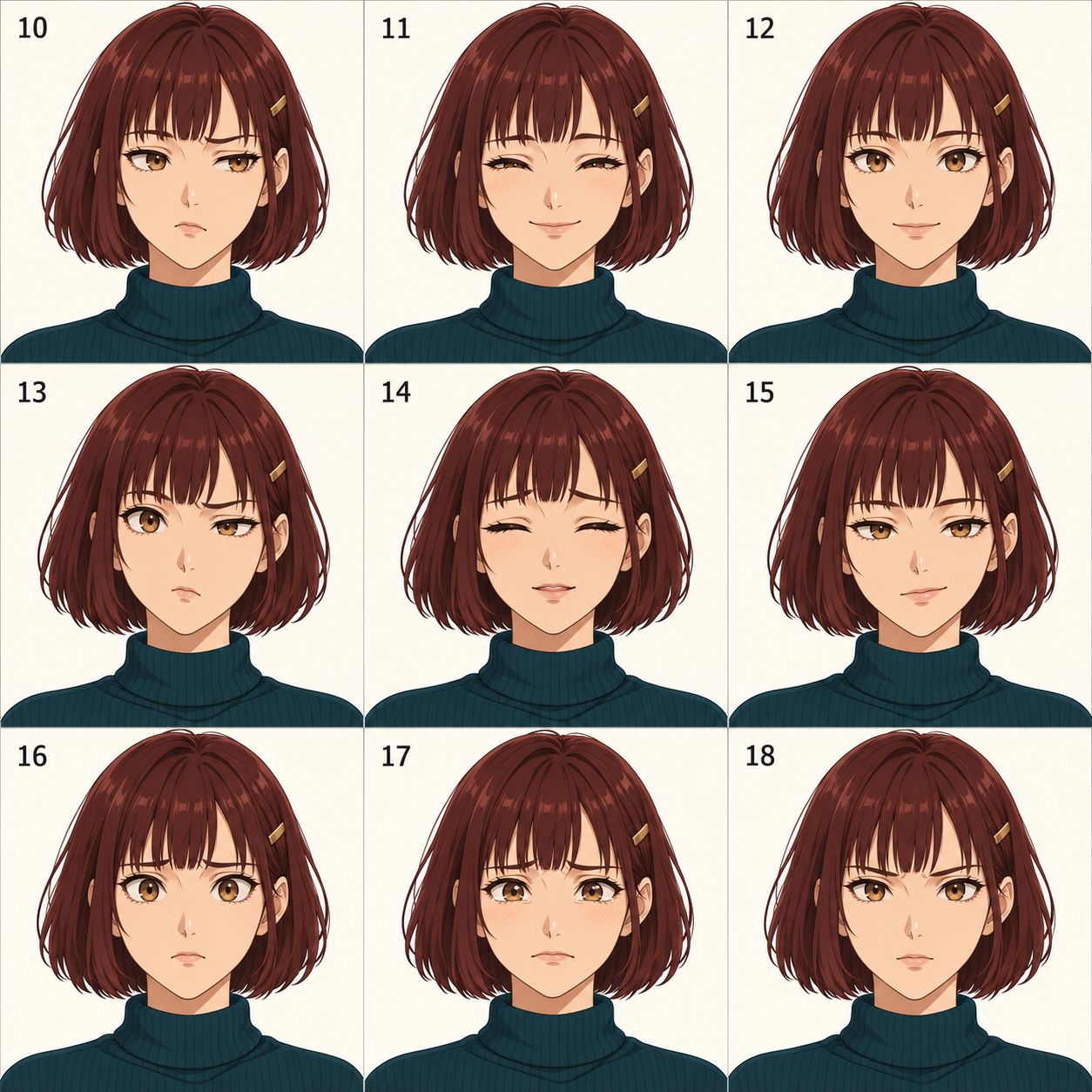
| Panel | Expression | Exact expression instruction submitted |
|---|---|---|
| 10 | Unimpressed | One brow slightly raised; half-lidded eyes looking forward; closed mouth with one corner subtly down; restrained skepticism without an angry frown. |
| 11 | Suppressed laugh | Relaxed brows; eyes narrowed by visibly lifted cheeks; lips firmly closed with both corners pulling upward; trying not to laugh; no teeth and no open mouth. |
| 12 | Polite smile | Level relaxed brows; evenly open eyes with little cheek lift; a small symmetrical closed-lip smile; courteous and controlled, without a broad grin. |
| 13 | Doubt | One brow visibly raised; the opposite eye slightly narrowed; direct questioning gaze; lips closed with one corner tucked inward; no smile. |
| 14 | Relief | Brows relaxed and slightly lifted at the inner ends; soft partly closed eyes; lips gently parted with a faint relaxed smile; tension released without a broad laugh. |
| 15 | Contempt | One brow subtly raised; half-lidded eyes looking directly ahead; only one mouth corner lifted in a small disdainful smirk; no nose wrinkle and no friendly smile. |
| 16 | Contained fear | Inner brows raised and drawn together; wide alert eyes; lips pressed tightly closed; tense cheeks; afraid but trying to remain composed; no scream. |
| 17 | Trying not to cry | Inner brows visibly raised and drawn together; open glossy eyes with tense lower lids; closed pressed lips with downturned corners; no falling tears and no open-mouth sob. |
| 18 | Determination | Brows lightly drawn inward; focused steady forward gaze; firmly closed mouth and subtle jaw tension; resolute rather than enraged; no teeth. |
What to compare: suppressed laugh engages cheeks and eyelids harder than the polite smile. Contained fear closes and tenses the mouth instead of opening it like surprise. Trying not to cry adds wet eyes while the mouth stays shut.
Observed limits: unimpressed and doubt stay close in this run. Relief closes the eyes more than requested. Several panels are readable on their own, but the subtle labels still need a scene to mean much.
Sheet 3: Everyday and mixed feelings
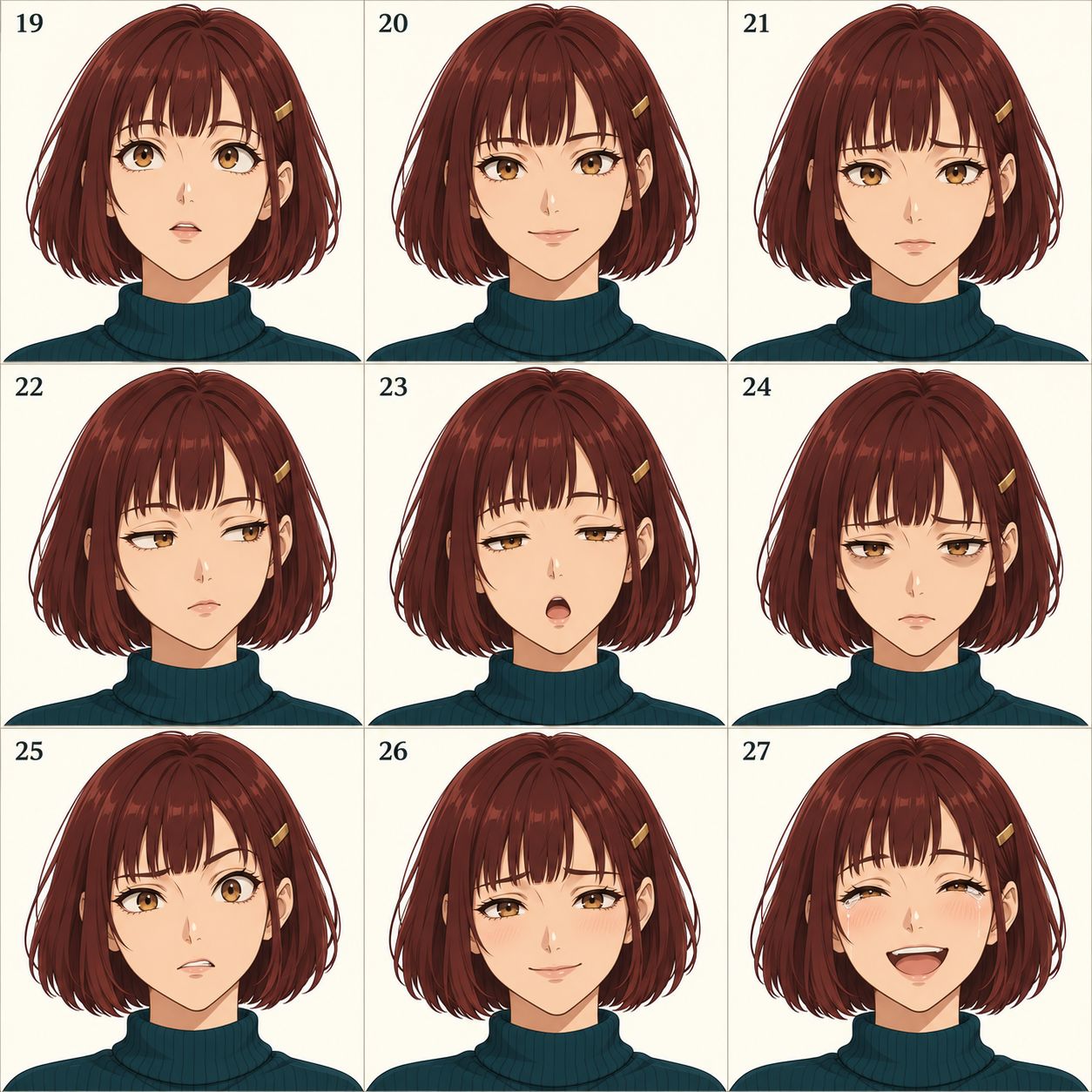
| Panel | Expression | Exact expression instruction submitted |
|---|---|---|
| 19 | Curiosity | Brows gently lifted; open attentive eyes focused on something slightly above the camera; lips softly parted; interested and relaxed, not startled. |
| 20 | Quiet pride | Relaxed level brows; bright direct eyes; a modest even closed-mouth smile; gently lifted cheeks; pleased with an achievement without a sneer. |
| 21 | Apology | Inner brows gently raised and drawn together; soft direct eye contact with the viewer; closed mouth with slightly lowered corners; gentle remorse without tears. |
| 22 | Boredom | Relaxed brows; half-lidded eyes looking away to her right; slack flat closed mouth; disengaged attention without an angry glare or head turn. |
| 23 | Sleepiness | Heavy drooping upper eyelids; unfocused eyes; relaxed brows; lips slightly open in a small sleepy yawn; no smile or distress. |
| 24 | Exhaustion | Drooping eyelids with visible mild under-eye shadows; brows lightly drawn together; relaxed downturned closed mouth; visibly drained while keeping the head upright. |
| 25 | Disbelief | One brow sharply raised; eyes wider than neutral and directed forward; mouth slightly open with one corner held tense; skeptical surprise without a scream. |
| 26 | Bittersweet smile | Inner brows gently raised; soft slightly lowered eyes; a small closed-mouth smile with modest cheek lift; warmth mixed with sadness; no falling tears. |
| 27 | Joyful tears | Relaxed lifted brows; eyes wet and narrowed by raised cheeks; a clear open smile; a few visible tears paired with happiness rather than sobbing. |
What to compare: boredom redirects attention, sleepiness adds a yawn, exhaustion brings under-eye shadows and a drained closed mouth. Joyful tears pairs a smile with tears; trying not to cry keeps the lower face tense.
Observed limits: the model adds blush to the bittersweet smile, which that panel never asked for. Quiet pride and apology are restrained enough to read differently without context. Treat the labels as acting directions, not as unambiguous descriptions of inner states.
Sheet 4: Anime and manga reaction effects
These nine prompts use deliberately stylized drawing conventions. Eye symbols, a shadow band or a comic mark replace part of the normal face. Here you should let the specified effect override the usual instruction to preserve natural pupils or realistic detail.
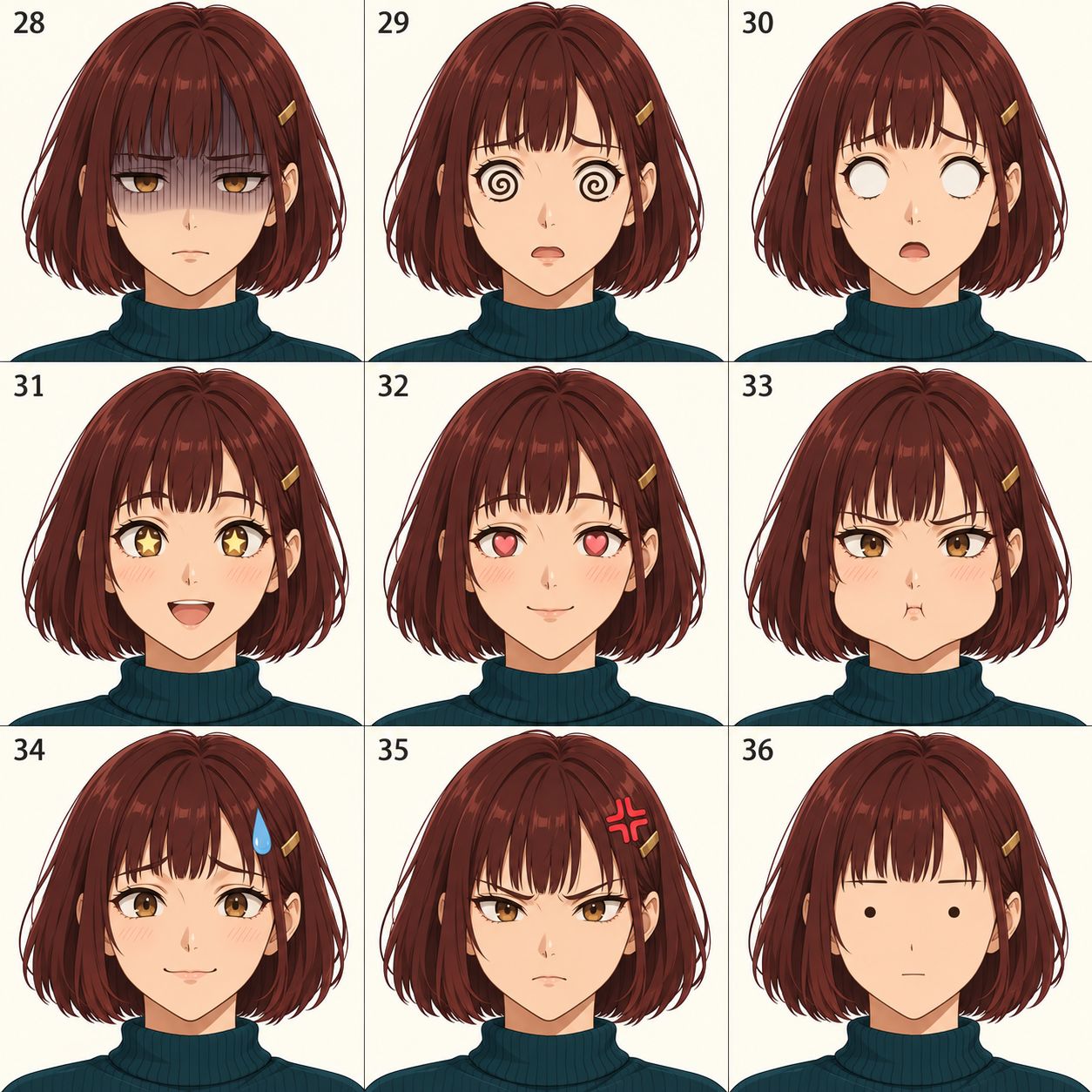
| Panel | Expression | Exact expression instruction submitted |
|---|---|---|
| 28 | Gloom shade | Level brows; a flat closed mouth; stylized dark hatching and a horizontal shadow band over the upper face; gloomy anime reaction while the background stays ivory. |
| 29 | Spiral-eyed confusion | Replace both irises with clean spiral symbols; raised uneven brows; small open mouth; a deliberate comic overwhelmed reaction, retaining the same hair and face outline. |
| 30 | Blank-eyed shock | Replace both eyes with simplified wide white eye shapes without visible irises; high raised brows; small open mouth; an exaggerated stunned anime reaction. |
| 31 | Starry admiration | Replace the main pupil shapes with bright star shapes inside the amber eyes; raised brows; eager small open smile; exaggerated delighted admiration. |
| 32 | Heart-eyed delight | Replace both pupils with simple warm pink heart shapes; relaxed raised brows; a delighted closed-mouth smile; playful nonsexual anime affection. |
| 33 | Puffed-cheek pout | Inflate both cheeks visibly; brows lowered toward the center; lips closed in a small central pout; playful annoyed anime reaction without a kiss pose. |
| 34 | Nervous sweat drop | Add ONE large stylized blue sweat drop beside her right temple, away from the left-side brass clip; raised inner brows; tense small closed-mouth smile; awkward anime nervousness. |
| 35 | Comic anger vein | Add ONE small red cross-shaped anime anger mark at her right temple, away from the hair clip; brows sharply down and inward; narrowed eyes; a closed tight mouth; no realistic injury. |
| 36 | Dot-eyed speechlessness | Simplify both eyes to tiny dark dot eyes; flatten the brows into small short lines; a tiny straight closed mouth; dead-still comic speechlessness; preserve hair, clip, clothes and face outline. |
What to compare: surprise in panel 07 keeps detailed amber eyes; blank-eyed shock in 30 removes the irises on purpose. Confusion in 09 works with brow and gaze cues; panel 29 replaces the eyes with spirals. Different visual treatments, not stronger versions of the same natural expression.
Observed limits: the sweat drop and anger mark land on the hair-clip side even though both prompts asked for the opposite temple. The symbols are visible; the placement wasn't followed. Some panels also pick up extra blush.
Use a shared setup, then add one expression
For a single portrait, start from a setup like this and append one table entry exactly as written:
Use the uploaded Rina portrait as the character reference.
Keep her face shape, auburn bob, amber eyes, left-side brass clip,
teal sweater, art style, ivory background and soft frontal light.
Use a front-facing head-and-shoulders portrait at eye level.
Keep the full hair silhouette inside the frame.
Change the facial expression as follows:
[PASTE ONE NUMBERED EXPRESSION INSTRUCTION]
This is a reusable template, not the full request that produced the four sheets. The expression clauses are the tested grid inputs; going from a grid to one portrait is a new generation and may behave differently.
For graphic eyes or manga marks, add an explicit exception: allow the requested symbol or local effect while preserving everything else. Otherwise "keep the eyes unchanged" fights "replace the pupils with hearts."
Brows, eyes, mouth and head angle are worth inspecting. They are not a universal weighting order that every model follows.
Choose a smaller set for the actual scene
You don't need all 36 for every character. Start with what the scene uses, compare against the neutral reference, and keep only results that are distinct and recognizable.
- Choose the performance. Does the scene need fear, surprise, restrained anger or a comic beat?
- Hold identity and framing. Don't change outfit, camera angle and background in the same request.
- Inspect the cues. Check eyes and mouth before you trust the label.
- Compare lookalikes. If doubt and unimpressed are interchangeable, revise one cue or drop one.
- Retry weak panels on their own. Go back to the approved portrait and regenerate just that expression.
- Save the request with the result. If you change the wording, version it and generate again.
A grid is handy for comparison, but it's one flattened image. Separate transparent PNGs, aligned sprites, layers and rigging are more work. A filename also doesn't teach a model what a reference means — supply the actual image.
When the expression is wrong, change the method
These are approaches to try, not extra tests run for these sheets.
Plain words before more words. A longer prompt isn't inherently more reliable. Stacked adjectives, unfamiliar synonyms and complicated psychological labels can make the target less clear. Describe what is visible: slightly lowered eyelids, a flat closed mouth, one raised brow. Add a cue that's missing; length alone won't raise your hit rate.
Separate the reaction from its intensity. For a small smile, ask for a slight lift at the mouth corners and a closed mouth. For a bigger one, add cheek lift or open the mouth. For restrained anger, light brow tension and pressed lips; save sharply lowered brows and bared teeth for a stronger performance. Move one cue at a time, and use concrete modifiers — "slightly," "gently," "widely" — only where the degree matters.
Mask the area you want changed. If only the mouth, the eyelids or a misplaced comic mark is wrong, select that region instead of asking for the whole sheet to be redrawn. Include the boundary the edit needs, then check the surrounding linework. If you hand it a circled annotation, say plainly that the circle marks the area to edit and must not appear in the output — a drawn circle is guidance, not a substitute for a real mask or selection tool. Even then, inspect the result.
Split face from effect, or supply a visual reference. A gloomy reaction may need both a restrained face and a local shadow treatment. Establish the face first, then add the shadow, symbol or mark in a separate edit. With multiple references, label the roles: image 1 supplies identity, image 2 supplies only the expression or graphic effect — and ask for that treatment without copying the second character's face, hair, clothes or background. Tag-oriented anime models may also respond to something like gloom (expression), but don't assume the tag or syntax travels.
Check what face cleanup did. If an automatic detailer or face-restoration pass changes the pupils, lips or brows, compare against the image from before that step. Adjust or bypass the cleanup for that test rather than piling on stronger emotion words over an already-correct face.
If your editor has a dedicated expression-strength control, treat it as its own setting. Writing a weighted phrase does not create a working intensity slider.
Common failures and focused fixes
| Problem | What to try |
|---|---|
| Every positive reaction becomes a broad grin | Specify a closed mouth, less cheek lift, or a smaller smile. |
| Deadpan looks sleepy | Keep the gaze attentive and lower the upper lids less. |
| Contempt looks like disgust | Use an asymmetrical mouth corner without a nose wrinkle. |
| Sadness and apology look identical | Use gaze direction and scene context, then compare the actual faces. |
| A comic symbol appears on the wrong side | Specify viewer-left or viewer-right; use a mask or selection to correct its location, or provide an annotated reference. |
| A grid repeats or merges expressions | Request numbered panels, or generate the weak expressions separately. |
| The hair is cropped or the head tilts | Request more headroom and upright alignment; check those constraints independently of the emotion. |
| The character changes along with the expression | Return to the approved reference and remove unrelated edits. |
Frequently asked questions
Are these the actual prompts used for the pictures?
Yes — the numbered expression instructions are verbatim excerpts from the four submitted grid prompts. Each request also included a character reference and longer layout and identity constraints. The expressions were generated nine per sheet, not tested independently as standalone short prompts.
Does the image follow every instruction exactly?
No. The notes above document the visible differences: head tilt, lookalike subtle reactions, extra blush, symbol placement. Leaving the source prompt untouched is what lets you see them instead of hiding them.
Should I use English tags or full sentences?
Use whatever prompting style your model supports. This guide uses plain-language directions. Don't assume a particular tag spelling or weighting syntax carries across anime models and image editors.
Can these still-image prompts be used for video?
Use the expression as a start state or an end state, then describe one clear transition and a pose to hold. Video may also need blinking, breathing, speech and camera instructions. These sheets are still-image examples; no video was generated for this guide.
Can I reuse the same face across all 36 expressions?
A shared portrait is a practical starting point, but check identity across outputs. Extreme mouth shapes and graphic eye replacements deliberately break recognizable features. Compare the stable design details and approve each result for its intended use.
Start with a recognizable face and a few reactions that genuinely differ. Expand the set when the next scene needs another performance.
To move from expression studies to scene creation, try the AI Anime Generator.