
Introduction
You found the Reddit thread. Someone dropped a Turbo LoRA for MiniMax H3, the clip rendered in a quarter of the time, and now every second post says "just use Turbo." Then you open the workflow and it wants a quantized checkpoint, a LoRA file, a custom sampler, and about 44 GB of memory. Meanwhile fal announced something also called H3 Max Turbo, and it is a different thing entirely.
If you make anime or OC stories, the question is not "which Turbo is real." It is "which shots are worth a fast draft, and where does the speed start eating my character." This guide explains how to tell the two Turbos apart, what each one gives up, and how to run a draft-fast, finish-clean workflow step by step so the fast pass never becomes the final look.
The two things called "MiniMax H3 Turbo"
MiniMax H3 Turbo (the LoRA). Not an official MiniMax release. It is a set of community distillations — LightX2V and others publish them on Hugging Face under Apache-2.0 — that sit on top of the open H3 weights and cut sampling from roughly 20 steps down to 4 or 8. The adapter itself is small, around 780 MB, but it needs the full H3 model underneath. This is what people mean when they search "turbo lora," "4 step," "sampler," or "workflow."
MiniMax H3 Max Turbo (fal's tier). A hosted preview that fal released in September 2026 by distilling its own H3 Max. Same prompt understanding, roughly twice the speed and half the cost, capped at 480p or 768p and 5 to 15 seconds. It does text-to-video and image-to-video with an optional end frame. It does not do reference-to-video — the mode that pins a character or style from your supplied images, clips, and audio stays with H3 Max.
Neither one is a new model. Both are the same H3 family taking fewer steps to get to a frame. That is the whole trade: fewer steps, less time, and some of the detail that those missing steps would have resolved.
How much faster, and where 4-step drafts break
Community measurements put the LoRA at about 3.1x faster on text-to-video and up to 6.8x on image-to-video; one RTX 5080 test clocked the 4-step setup at 3.44x the 20-step baseline. fal's own framing for H3 Max Turbo is simpler: a five-second 768p clip that took H3 Max under three seconds comes back in around half that.
What the numbers do not show is what the missing steps used to be doing. On the 4-step LoRA, testers report the same failure family again and again:
- Oversharpening and ghosting on fast motion — a whip pan or a hair flip leaves a faint trail.
- Motion trails on small objects — hands, hair ends, ribbons, anything thin that crosses the frame.
- Weaker quiet audio — H3 generates sound with the picture, and the 4-step distillation can flatten soft or sustained vocal registers.
The 8-step checkpoint fixes most of this and is still around twice as fast as the full model. For anime work that is the version worth knowing: 4 steps for "does this framing work," 8 steps for "is this clip close," full steps or H3 Max for "this is the shot."
What H3 Max Turbo trades away
fal's tier is the cleaner option if you are already on a hosted pipeline: no checkpoint, no memory budget, 24 fps, native stereo audio generated alongside the picture, six aspect ratios including 9:16 and 21:9. fal targets the 97th percentile of H3 Max on its own evaluations and says Turbo still scores above base H3.
The trade is the one that matters most for character work: no reference-to-video. Turbo will take a prompt and a start image, and it will follow directions well. It will not hold a face across five shots from a set of reference images, because that mode is not there. So Turbo is a draft engine for blocking, timing, and composition — not the place where your OC's identity gets decided.
Which shots are worth a Turbo draft
Use the fast pass for questions that a slightly soft frame can still answer:
- Blocking. Does the character enter from the left or the right? Where does the second character stand?
- Camera. Is this a slow push-in or a static wide? Does the tilt reveal the sign in time?
- Timing. Does a 5-second beat feel rushed? Would 8 seconds sag?
- Variations. Three versions of the same reaction, pick one, move on.
Do not use the fast pass for anything you will judge on identity or texture:
- Close-ups where the face is the shot.
- Hero frames that become thumbnails or covers.
- Any shot where thin detail — hair ends, a glowing sigil, a ribbon — crosses the frame under motion.
- Dialogue with quiet delivery, because that is exactly where 4-step audio gets thin.
The rule of thumb: Turbo answers where and when. The full model answers who and how it looks.
How to run draft-fast, finish-clean in ArcLoop
You do not need a local rig to work this way. MiniMax H3 and H3 Max both run inside ArcLoop, and H3 Max generates a 5-second 480p clip in around 3 seconds with image, video, and audio references — fast enough to iterate, with the reference mode that Turbo drops. Here is the workflow step by step.
Step 1 — Lock the character before you draft anything. Open a project in ArcLoop Worlds, build your OC as a character asset in My Assets, and bind its main image and a few reference images (turnaround, key outfit, one expression). Every draft and every final will reference the same asset, so identity is never something a fast pass has to get lucky on.
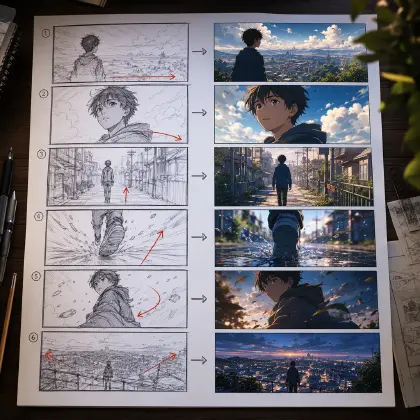
Step 2 — Draft with @ references, not descriptions. In the Storyboard, write each shot description with @YourCharacter instead of re-describing the face. The description carries only what is new in this shot: action, camera, light, mood. Generate at the shorter length first. You are checking blocking and timing, so read the draft for where and when, and ignore soft edges.
Step 3 — Sort drafts into three piles. Approved as-is (rare, usually wide shots with little motion), approved framing but regenerate (most of them), and wrong idea (rewrite the description, not the prompt wording). Keep the good framings — you will reuse the exact shot text.
Step 4 — Finish the shots that carry identity. For close-ups, hero frames, and anything with thin detail in motion, regenerate the approved shot text with H3 Max and the full reference set attached. Same @ reference, same description, only the model and the reference mode change. Compare against the draft: framing should match, face and hair should now hold.
Step 5 — Fix one layer at a time. If the finish is close but the hands are wrong, edit the action line in the shot description and regenerate that one shot. Do not go back to a fast draft to "explore" a shot that already has an approved framing — that is how a project ends up with six versions of the same beat and no final.
If you are chaining clips into a longer scene, the same split applies: draft the sequence order fast, then finish the clips that hold the cut. MiniMax H3 clip chaining for longer videos covers the continuation side.
Example 1: a fast draft to check blocking
Wide shot of @Rin Aoyagi and @Detective Sato in the rain-soaked alley scene asset. Rin enters from the left under a broken awning, stops two steps short of Sato, who does not turn around. Static camera at chest height, slight low angle. Cold blue sodium light from the right, wet ground reflections. Hold the beat for four seconds, no dialogue. Draft for blocking only.
This is a Turbo-style draft: wide, static, no faces to judge. You are checking whether "two steps short" reads at this distance and whether the awning frames the entrance. If the blocking works, the description is done — keep the text and move to the finish pass.
Example 2: the finish pass on the same beat
Medium close-up of @Rin Aoyagi in the rain-soaked alley scene asset, same position as the wide shot. She keeps a flat expression but her hand closes around the folded letter in her coat pocket. Slow push-in over five seconds. Cold blue key light from the right, rain streaks catching the rim light on her hair. Quiet room tone, distant traffic, no music.
Same beat, but now the shot is about her face and her hair under rain — exactly where a 4-step draft would smear. Generate this one with the full reference set attached to @Rin Aoyagi so the model works from her bound images instead of the prompt. Notice the description still never mentions her eye color or coat: that lives in the asset.
Example 3: regenerating only the failed layer
Same shot as the medium close-up of @Rin Aoyagi. Keep framing, light, and push-in. Change only the hand action: she pulls the folded letter halfway out of her pocket and stops. Five seconds. Everything else unchanged.
When a finished shot is right except for one action, you edit one line and regenerate one shot. You do not open a new draft round. This is the discipline that makes fast drafts pay off: speed goes into exploring, not into re-exploring what was already approved.
Five ways H3 Turbo drafts go wrong
Treating the draft as the final. A 4-step clip that "looks fine on the phone" is the one that shows trails on a monitor. If the shot carries identity or thin detail, finish it.
Exploring with the full model. The opposite mistake: burning long generations on blocking questions a fast pass would answer. Speed belongs at the front of the process.
Judging identity from a mode that cannot hold it. H3 Max Turbo has no reference-to-video. If a character drifts in a Turbo clip, that is not a prompt problem, and rewording will not fix it — switch to the mode that takes references.
Fixing the description instead of the layer. When one hand is wrong, change the action line. When the light is wrong, change the light line. Rewriting the whole description throws away the framing you already approved.
Buying a rig for a question you can answer hosted. The local LoRA route is real, but roughly 44 GB of memory for a fully quantized setup is a lot of hardware to own for "does this framing work." If drafting speed is the goal, a hosted fast tier with your assets attached gets you there without the setup.
FAQ
Is MiniMax H3 Turbo an official MiniMax model?
No. The Turbo LoRA is a community distillation on top of the open H3 weights. H3 Max Turbo is fal's own distilled tier of H3 Max, released as a preview. MiniMax's own lineup is H3 and H3 Max; see MiniMax H3, explained for the family.
How much faster is the Turbo LoRA than regular H3?
Reported ranges run from about 3x on text-to-video to nearly 7x on image-to-video, depending on steps and hardware. The 8-step checkpoint gives up some of that speed for noticeably cleaner motion and audio.
Can H3 Max Turbo keep my character consistent from reference images?
No. Reference-to-video is not part of the Turbo tier. For shots that need a face to hold from supplied references, use H3 Max with references attached — MiniMax H3 Max for anime walks through that mode.
Do I need a local GPU to draft fast with H3?
Not for this workflow. H3 Max inside ArcLoop returns a 5-second 480p clip in about 3 seconds with references attached, which is fast enough for blocking and timing passes without a local setup. See the MiniMax H3 Max model page.
How do I decide which shots get the fast pass?
Ask what you will judge the shot on. Blocking, camera, and timing: fast pass. Face, hair, thin detail in motion, quiet dialogue: finish pass. AI anime cost control has the same split applied to a whole episode budget.