A normal face suddenly snapping into an exaggerated expression, a coat hem still swaying after a character stops short, a leaf tip gently springing back as a raindrop falls—these small changes are often what make a shot work. When generating anime videos with AI, you can build your 2D animation prompts around these changes, then add camera angles, sound, and the order of events.
Below, we will look at several generated clips to see how to write prompts for anime expressions, action, atmospheric cutaway shots, emotional backgrounds, and visual effects. The quoted English lines are excerpts from the full prompts used for each example. You can swap out the characters and actions as needed, or try these prompt patterns in the AI Anime Generator.
Define the Art Style First
It works best to write the art style as a standalone block and keep it at the very beginning of every prompt. When generating multiple shots or separate clips, reuse that exact block and only adjust the action, setting, and camera descriptions for each shot. Keeping the wording and structure fixed helps maintain consistency, though you will still need to check the final footage after generation.
Here are a few common art styles. You can pick one as a starting point, then add specific details for linework, coloring, and backgrounds.
| Art Style | English Prompt |
|---|---|
| Japanese 2D anime | Japanese 2D anime, clean linework, flat colors. |
| Hand-drawn cel animation | Hand-drawn 2D animation, flat cel shading, crisp shadow edges. |
| Watercolor hand-drawn animation | Hand-drawn 2D watercolor animation, soft colors, painted backgrounds. |
| Classic hand-drawn cartoon | Classic hand-drawn 2D cartoon animation, rounded shapes, expressive poses. |
| Charcoal sketch animation | 2D charcoal sketch animation, rough strokes, visible paper texture. |
A LoRA can also help keep the art style consistent, which is common with open-source models that support LoRA. Using one requires preparing style-consistent reference images, training, and tuning; the number of images needed depends on your goal and the model, and does not necessarily require a huge dataset.
Using reference images is more direct: lock in the art style for your main characters and settings first, then use those images as the first frame or as style references. When the model supports these features, reusing the same set of reference images across multiple shots alongside a fixed style prompt usually makes it easier to keep the visuals consistent.
Exaggerated Anime Expressions
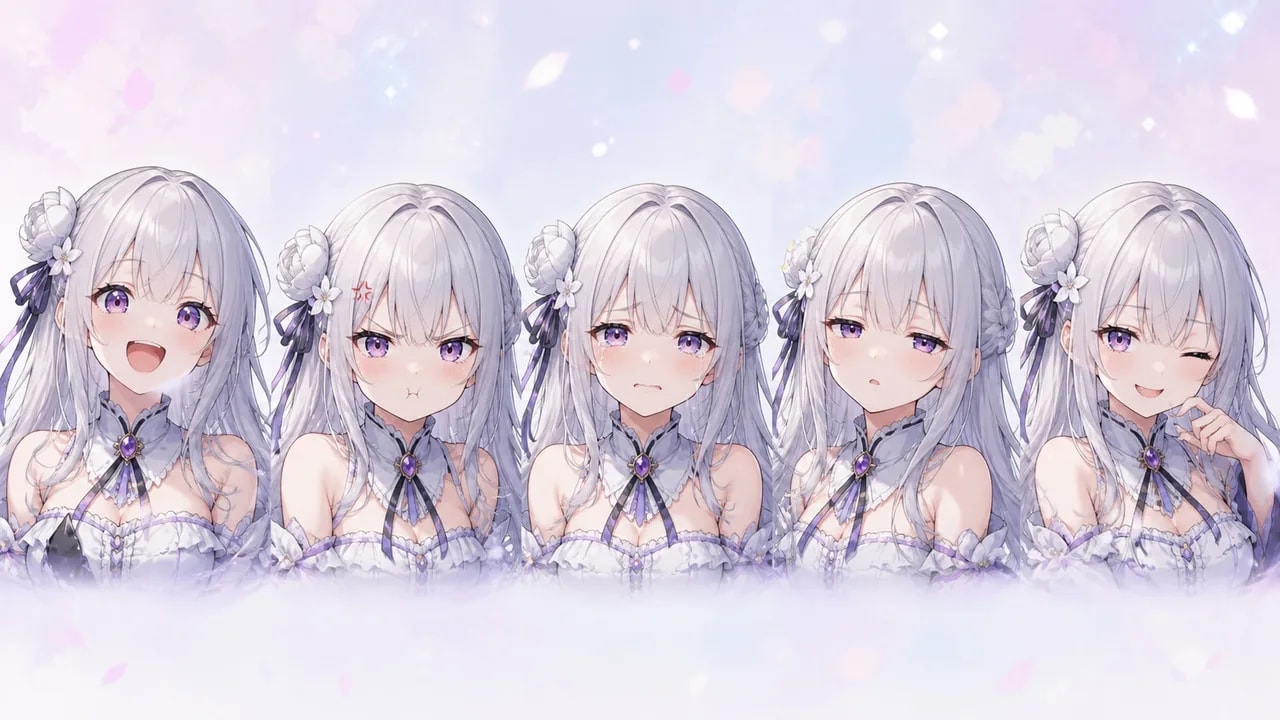
An exaggerated anime expression works by changing how the facial features are drawn at the exact moment an emotion shifts. When a normally proportioned face suddenly gets wide-eyed in shock, the contrast shows right away. When writing the prompt, focus on how the eyes widen, how the pupils shrink into tiny dots, how the jaw drops, or which facial features simplify into basic lines.
To make sure the viewer catches this switch, the sequence of events matters: start with a normal expression, suddenly deform the face the instant the character reacts, hold for a beat, and return to normal if needed. Leaving a brief pause gives the viewer time to read the reaction, without needing to lock it to exact timestamps. If you are working with a storyboard, you can prepare one reference image for the normal face and another for the exaggerated face, and note that the transition between them is a sudden snap so the model does not treat a brief reaction as the character's default look.
Be clear about what changes and what stays the same: is it only the facial features distorting, or does the whole body turn into a chibi figure? Hairstyles, hair color, and signature accessories usually stay as they are. Lock down the main change first, and leave a little room for the rest.
In the example below, the character looks down at her phone first, then suddenly snaps into an exaggerated shocked face. The English prompt has her say "Huh?" first, pause for a tiny beat, and only then deform her eyes, pupils, and mouth, while adding a short sound effect and a yellow radial-line background. The key is pausing first, then transforming:
She freezes for a tiny beat, then her face snaps into an extreme anime shock expression: huge white oval eyes, tiny black dot pupils, and a long dropped jaw, with stiff raised shoulders.
The generated clip shows big white eyes, shading across the forehead, and clenched teeth. The contrast of a normal face suddenly deforming comes through, even though the exact way the facial features are drawn differs a bit from the text description.
MiniMax H3 Max · 6s · 720p (exported from native 768p) · Audio
Full English Prompt
A six-second colorful hand-drawn 2D anime comedy shot, fixed camera, chest-up. A young adult woman with short dark teal hair, amber eyes, and a coral shirt holds a phone just below frame in a softly lit pale blue room. Begin with normal anime facial proportions and a relaxed face. During the first two seconds she glances down at the phone and clearly says in English, "Huh?", with synchronized mouth movement. Finish the word before the facial transformation. She freezes for a tiny beat, then her face snaps into an extreme anime shock expression: huge white oval eyes, tiny black dot pupils, and a long dropped jaw, with stiff raised shoulders. A brief yellow burst of radial lines replaces the room at the instant of shock. Hold this comically distorted face for the rest of the shot as she slowly raises her gaze toward the camera. Keep the same hairstyle, clothing, and character. Sharp timing, clean cel shading, subtle hair follow-through. Audible female voice saying only "Huh?", followed by a short cartoon pop exactly as the face changes, quiet room ambience, no music or subtitles.
Pacing and Impact in Anime Action
Action scenes in 2D animation can be more exaggerated and punchy than live-action performance. Body stretches, mid-air turns, and sudden bursts of speed that are hard to pull off in live-action filming can all be drawn in anime. When writing action prompts, go beyond stating what the character does—describe how far the movement is pushed, where it suddenly speeds up, and where it pauses briefly.
Take a fight in a rainy alley as an example: a young woman ducks low to dodge a blade, kicks up a splash of water to blind her opponent, closes the distance, and slips away. Her body moves first while her hair and coat hem follow a half-beat later. That slight delay gives the motion a clear sense of wind-up, burst, and follow-through.
To push the sense of speed further, you can add speed lines, afterimages, stretch deformation, or a frame or two of black-and-white impact, as long as you specify when they appear. For instance, an afterimage might show up only during a quick dodge, speed lines can pull along the direction of movement, a splash of water can show the force of her footing, and the image returns to normal right after.
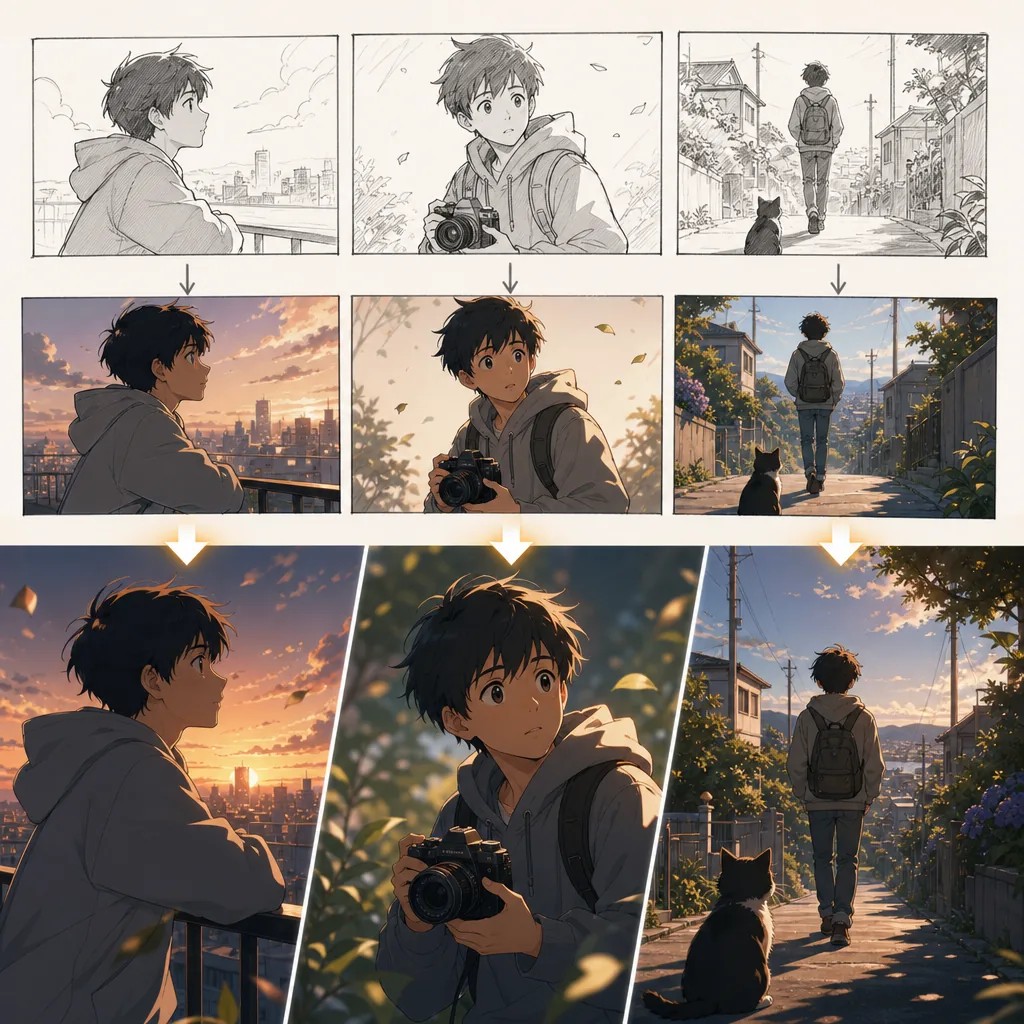
If you combine this with a storyboard, you can sketch out the key poses—dodging the blade, kicking water, closing in, and slipping past—and use text to fill in the transitions between them. Make sure the storyboard notes specify each character's left-to-right position in the frame, their direction of movement, and which hand holds the weapon. When cutting between shots, whether a weapon is drawn or dropped also needs to match the previous action.
In the rainy alley example below, this continuous action is laid out in a 3x3 storyboard grid. After generating the full storyboard sheet, a few hands and poses were adjusted before passing it to the video model. Along with the reading order, the prompt specifies the pacing of the movement:
Strictly follow the nine-panel storyboard in Image 1, reading left to right, top to bottom.
Sharp anticipation, explosive movement, brief impact holds, speed lines, and trailing hair and clothing.
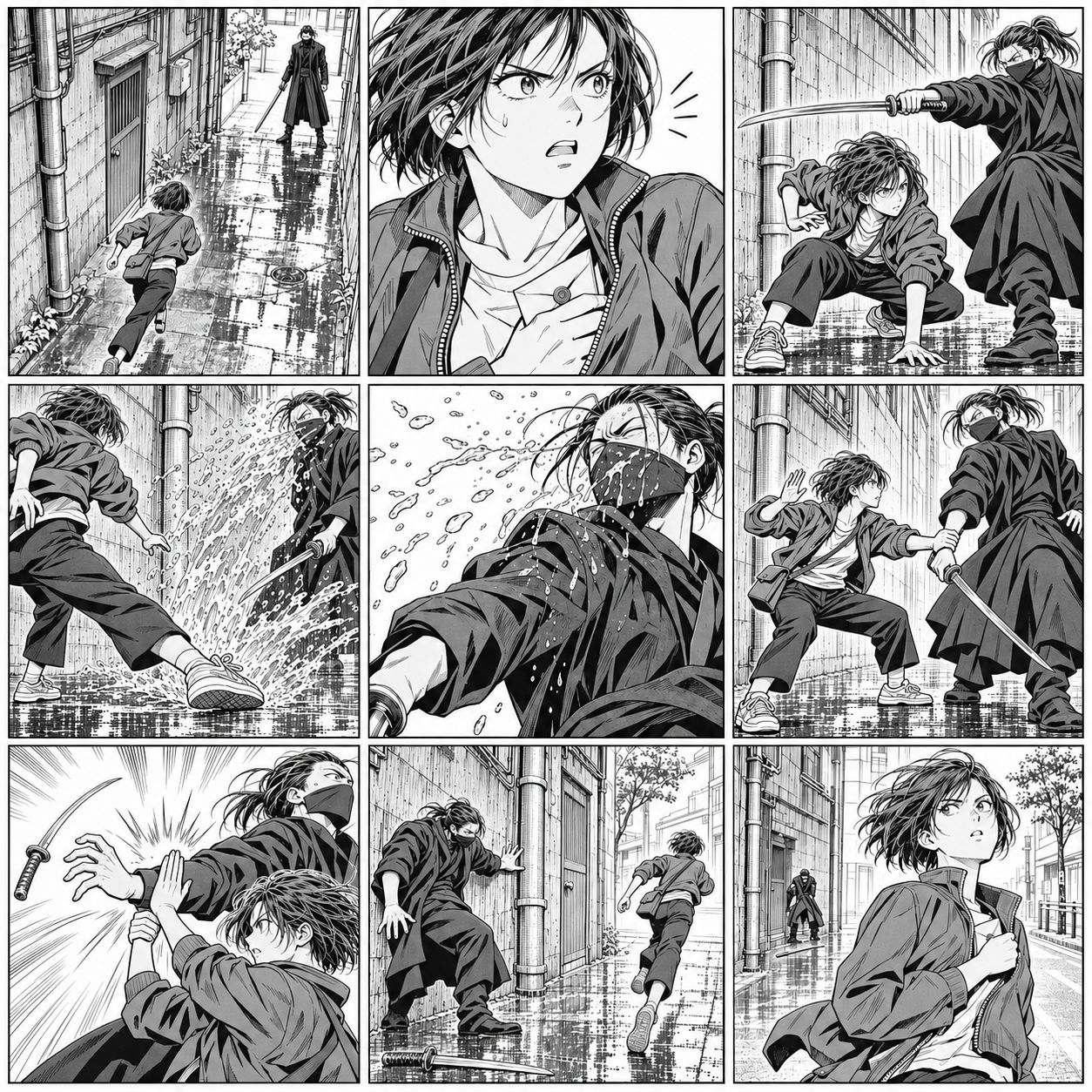
Looking at the final clip, the energy of the poses in the storyboard holds up well. Speed lines and key poses come through via fast strikes, slowed motions, and brief pauses, and the shifts between fast and slow give the fight more weight. The pause during the disarm in the middle lingers a bit too long, and the final look back at the end is left out, which can be tightened up in editing.
Seedance 2.5 · 15s · 720p · Audio
Full English Prompt
Strictly follow the nine-panel storyboard in Image 1, reading left to right, top to bottom. Expand each panel into a full-screen animated shot in this order:
1. A young adult female courier runs into a wet alley; a masked swordsman blocks the exit.
2. Close-up: she protects the sealed envelope inside her jacket and spots the threat.
3. He slashes horizontally; she crouches low, left palm on the ground, right hand near her chest, ducking beneath the blade.
4. She kicks a puddle, sending water toward his face.
5. Close-up: the splash makes him flinch and shut his eyes.
6. She rises into range, left hand gripping his right sword wrist, right palm drawn back.
7. Keeping that grip, she strikes his forearm with her right palm; his fingers release the sword.
8. The sword lands in the puddle and stays there as she slips past him toward the exit.
9. She looks back while protecting the envelope; he remains behind, empty-handed.
Render the monochrome reference as colorful hand-drawn 2D anime. Preserve character designs, clear arm anatomy, and alley geography. Sharp anticipation, explosive movement, brief impact holds, speed lines, and trailing hair and clothing. Continuous action across cuts; no panel borders, split screens, text, or slideshow. Synchronized rain, splashing footsteps, blade whooshes, impacts, and a metallic sword landing; no dialogue.
Building Atmosphere with Anime Camera Work
Anime often uses cutaway shots, small movements, and clean cuts to set a mood. Take a morning raindrop sliding down a leaf, where the camera stays on one small process: the drop slides slowly, hangs at the tip, falls, and the leaf tip gently springs back. Write the prompt in that exact order, leaving enough time for the drop to hang and fall so the motion reads clearly.
Be clear about the lighting and background as well—for instance, morning light passing through the water drop against soft, blurred patches of color. Specify that the camera stays fixed and holds on the shot, so the model does not add unnecessary camera movement.
The same approach works for other everyday details: a curtain slowly puffing out and settling in a breeze, steam rising and thinning from a cup, or ripples spreading across a puddle after a raindrop hits. Stringing these small, observational shots together in the order a person's gaze would naturally follow creates a calm, natural opening sequence.
The example below, generated with MiniMax H3, starts on a raindrop at the tip of a leaf after a shower, then cuts inside a classroom: a student lifts her eyes from her book and slowly turns her head toward the window. Both shots keep the same hand-drawn 2D style. The prompt sets summer cicadas as continuous ambient sound across both shots, and specifies when the water drop sound and the rustling curtain come in.
Exactly two shots, with a clean cut at four seconds.
Audio: clearly audible summer cicadas continue across both shots, a delicate drop sound in the opening, faint wind and curtain rustle in the classroom.
MiniMax H3 · ~10s · 720p (exported from native 768p) · Audio
Full English Prompt
A ten-second Japanese 2D anime scene with synchronized summer ambience. Both shots share the same hand-drawn animation style: visible ink contours, simplified painted shapes, flat cel-shaded colors, and softly painted backgrounds. Exactly two shots, with a clean cut at four seconds.
0-4 seconds: A still close-up of a green leaf outside a school after a summer shower. Draw the leaf and raindrop as anime artwork, with simple outlined shapes and stylized white highlight strokes. A single drop slides slowly toward the tip, hangs briefly, then falls; the leaf tip gently springs back. The background is a softly painted wash of green trees and warm summer light. Avoid photographic macro textures, photorealism, or 3D rendering.
4-10 seconds: Cut to a quiet classroom drawn in the same 2D anime style. A young adult student with short dark teal hair sits at a wooden desk beside an open window on screen left. Fixed medium-wide three-quarter view from the aisle. She looks down at an open book, lifts her eyes, then slowly turns her head left to gaze outside. Hold her quiet gaze. A thin curtain and a few strands of hair move gently in the breeze. No further cuts or zooms.
Audio: clearly audible summer cicadas continue across both shots, a delicate drop sound in the opening, faint wind and curtain rustle in the classroom. No dialogue, music, subtitles, or text.
Showing Emotion Through Background Changes
Anime can show what a character is feeling directly by abruptly changing the background. The character stays right where they are, while the classroom behind them vanishes in a single frame into a blank blue-gray backdrop; add a dry gust of wind while the character freezes in place, and the awkwardness and deflation come across immediately. Expression, posture, background, and sound can all work together to show the mood.
To write a shot like this, lay out the trigger and the changes in order: what line or action sets off the emotion, how the original background disappears and what replaces it, and how the character reacts right after. For example, after hearing a remark, the classroom vanishes, the character turns stone gray as if briefly petrified, a gust of wind moves her hair, and the shot holds on an awkward silence. Keeping the character's position, hairstyle, and clothing fixed while letting her expression, posture, and background shift with the mood makes the transition much easier to follow.
In the example below, "That wasn't a compliment." is delivered as an off-screen voice-over while the character stays silent and reacts only through her eyes and posture. Once the background drops away, a gust of wind stirs her hair and the shot holds on her deflated look. The English prompt specifies the exact timestamp for the background switch and makes it clear that the character does not speak:
At 2 seconds, the classroom vanishes in a single frame, replaced by a completely empty pale blue-gray backdrop.
The woman does not speak or lip-sync.
MiniMax H3 · ~5s · 768p · Audio
Full English Prompt
A five-second Japanese TV anime comedy shot. Refined Japanese anime character design, expressive eyes, delicate ink contours, restrained cel shading, softly painted classroom background, and snappy limited-animation timing. One fixed waist-up shot of a young adult woman with short dark teal hair and a coral jacket.
0-2 seconds: She stands silently in the classroom with a small proud CLOSED-MOUTH smile. An adult MALE NARRATOR, heard only as non-diegetic voice-over, dryly says in English: "That wasn't a compliment." The narrator is outside the story and never appears on screen. The woman does not speak or lip-sync. Her lips remain closed and motionless throughout the entire clip, including while the narration plays.
At 2 seconds, the classroom vanishes in a single frame, replaced by a completely empty pale blue-gray backdrop. All desks, walls, windows, and blackboards disappear. Keep the woman in the same position.
2-5 seconds: Her closed smile becomes a tiny CLOSED stunned line; her eyes droop blankly and her shoulders sag. Her skin and clothes turn stone gray with a few fine drawn crack lines: the Japanese anime gag of being petrified by embarrassment. Her body freezes. A single dry gust crosses the blank backdrop, marked by brief hand-drawn wind streaks; only her hair tips and jacket hem flutter once. Hold the awkward stillness.
Audio: off-screen male narration first, then a lonely wind whoosh fading into silence. No voice from the woman, mouth movement, music, flowers, sparkles, subtitles, camera moves, or extra cuts.
Anime Effects, Anime Effects, and More Anime Effects
Anime is full of magic, superpowers, and martial arts effects: magic circles unfolding in layers, drifting ghost flames, electricity arcing along a blade, or shockwaves rippling outward with a strike. The shape, direction, and timing of an effect tell the viewer how a character charges up and releases an attack.
Take drawing a sword to summon lightning: when the blade is drawn halfway out of the scabbard, the character pauses. Blue light runs along the exposed steel, and fine branching sparks jump between the blade and the scabbard mouth. Then the character steps forward and finishes the draw, flinging the stored electricity out as a bright arc that races forward and quickly vanishes. Pausing to charge first and slashing to release second makes the rhythm of the move clear.
When writing the prompt, it helps to separate how the effect looks from how it moves. For example, the lightning can have a bright thin core that branches into jagged bolts with rapidly flickering edges; once swung, it follows the path of the blade and briefly lights up the hands, clothes, and ground. If you are breaking the sequence into shots, you can use a medium shot to set the stance, cut to a tight close-up of the half-drawn blade, and finish with a wide shot for the full draw and electric arc so both the small details and the big swing have room to play out.
The prompt excerpt below breaks the "half-drawn pause" into its own beat and specifies where the blue light and branching sparks appear:
He slowly draws the katana HALFWAY OUT and pauses. Half the steel blade remains inside the scabbard. Blue light runs along the exposed steel; fine branching lightning filaments crawl and snap between the blade and scabbard mouth.
Seedance 2 Fast · ~7s · 720p · Audio
Full English Prompt
A seven-second colorful 2D Korean action-manhwa sequence, three connected shots. A strikingly handsome adult male swordsman with layered black hair and sharp eyes wears a fitted modern black jacket over a gray shirt, dark trousers, and black boots. He stands on a quiet city street at night, a single katana sheathed at his left hip. Refined webtoon linework, elegant proportions, polished cel shading, and cool cinematic lighting.
0-2 seconds, medium three-quarter shot: He lowers his center of gravity and turns his torso slightly, right hand closing around the sword hilt while his left hand firmly holds the scabbard. His jacket shifts with the preparation.
2-4 seconds, tight close-up framing the hilt, exposed blade, and scabbard mouth: He slowly draws the katana HALFWAY OUT and pauses. Half the steel blade remains inside the scabbard. Blue light runs along the exposed steel; fine branching lightning filaments crawl and snap between the blade and scabbard mouth. Clearly show the half-drawn sword.
4-7 seconds, wide side view: He suddenly steps forward, rotates his hips, and completes the draw in one explosive sweeping slash toward screen right. The sword releases a single brilliant blue electric arc that races forward, its narrow crescent edge branching into jagged bolts before vanishing. He finishes in a stable low stance, fully drawn sword visible, coat hem trailing. Keep the sword and hands anatomically clear and continuous across cuts. Lightning has sharp branching shapes and rapid flicker, not flame-like movement.
Audio: quiet night ambience, a metallic blade sliding from the sheath, close electrical crackles during the pause, then a sharp unsheathing snap and powerful electric whoosh at the slash. No dialogue, music, text, or panel borders.
Combining Multiple Effects: Dividing Roles Between Wind, Ice, and Lightning
When putting several elements into the same fight, it helps to give each one a distinct job. Wind helps the swordsman dodge a heavy slash and boosts his speed for the counterattack; ice spreads across the ground to lock the opponent's front boot in place; lightning gathers along the blade and saves its burst for the weapon clash.
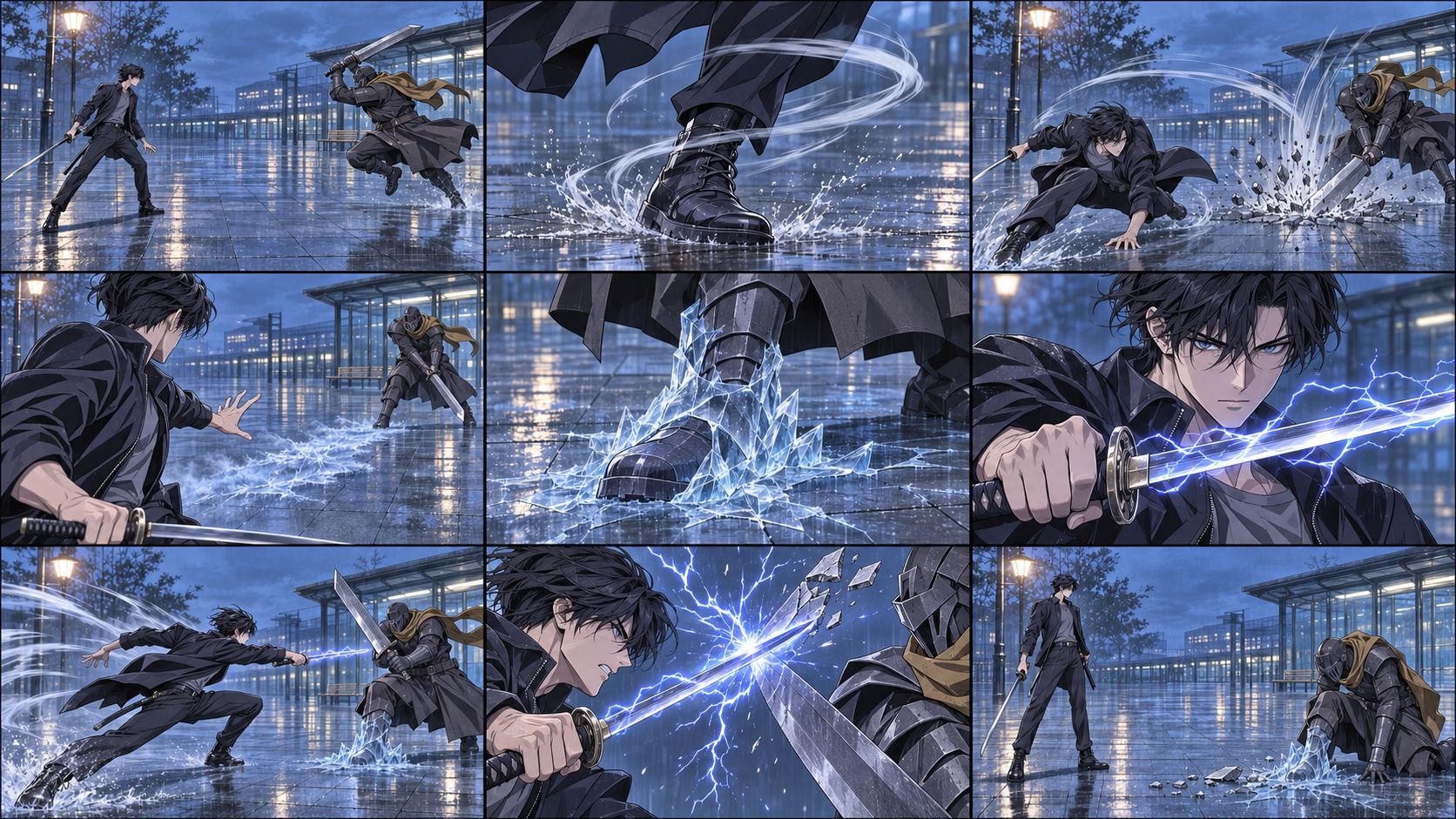
The 3x3 storyboard below breaks this sequence into key shots: a wide shot establishes both positions, a foot insert brings in the wind, an over-the-shoulder shot shows the frost advancing, and close-ups of the frozen boot and lightning-charged blade set up the final lunge. When writing the video prompt, follow the storyboard order and fill in how each move starts, which way the effect travels, and what marks are left behind after the clash.
While the full prompt expands on the fight shot by shot, this single line sums up how the three elements divide the work across the scene:
Wind redirects and accelerates the hero; ice traps the enemy; lightning wins the clash.
Seedance 2.5 · ~15s · 720p · Audio
Full English Prompt
Strictly follow Image 1 as a nine-shot storyboard, reading left to right, top to bottom. Create a continuous fifteen-second colorful 2D Korean action-manhwa fight. Preserve both character designs, modern clothing, weapons, elemental effects, wet station plaza, streetlamp and transit shelter. Expand every panel into a full-screen moving shot, removing the grid and borders.
1. 0-1.5s, wide: the handsome black-haired swordsman stands screen left; the masked armored opponent charges from screen right with his broad sword raised.
2. 1.5-2s, low foot insert: the hero pivots in a puddle as pale wind coils around his boot.
3. 2-4s, side action shot: a wind-driven dodge carries the hero into the left foreground; the enemy's heavy slash strikes his former position, scattering wet stone chips.
4. 4-5.5s, over the hero's shoulder: his free LEFT palm sends frost across the paving toward the enemy. His RIGHT hand continues holding the drawn katana.
5. 5.5-6.5s, low close-up: sharp ice locks the enemy's forward boot to the ground and interrupts his movement.
6. 6.5-8s, face-and-blade close-up: the hero focuses; fine branching blue lightning gathers along his intact katana. The sword remains drawn.
7. 8-10s, low wide: wind propels a forceful left-to-right lunge, hips turning and jacket trailing. The enemy cannot retreat because his boot is frozen, and raises his broad sword to guard.
8. 10-12s, tight weapon clash: the katana meets the broad sword; a brilliant electric arc bursts at contact and breaks the broad sword's tip. Keep the hero's katana intact and show readable blade contact.
9. 12-15s, wide aftermath: the opponent kneels at right with the visibly broken weapon and cracked ice around his boot. The hero settles at left into a controlled finishing stance. Wind, blue sparks and ice fragments subside.
Use motivated match-action cuts, sharp acceleration and brief impact holds, detailed hand-drawn effects and clear anatomy. Preserve screen direction and weapon continuity. Wind redirects and accelerates the hero; ice traps the enemy; lightning wins the clash. No slideshow, split screens, text, extra characters, or extra attacks.
Audio: synchronized splashing footsteps, wind bursts, heavy sword impact, spreading ice and freezing cracks, electrical crackles, steel collision and breaking metal, fading plaza ambience. No dialogue or music.
Wrapping Up
Looking back across these six examples, a few habits carry through when writing 2D animation prompts: lay out visual changes in a clear order and leave brief pauses at key moments; set clear boundaries around what changes and what stays the same; and place sound cues and camera cuts along the same timeline. For complex action sequences, you can lock down the key poses with a storyboard first, check the pacing against the generated clip afterward, and smooth out any rough spots in editing.